

Picture an unfinished basement with concrete floors, exposed framing, and storage shelves. Now suppose the county records describe the space as finished living area. If the error inflated the assessment, the homeowner is paying taxes based on incorrect information.
A higher payment does not prove an assessment error. Taxes, insurance, and escrow shortages all affect the amount due. But before accepting the increase, check the numbers behind the payment.
As a mortgage loan officer serving Franklin, Nashville, and Middle Tennessee, I want homeowners to understand their full housing cost. The interest rate deserves attention. So do the taxes and insurance collected alongside principal and interest.
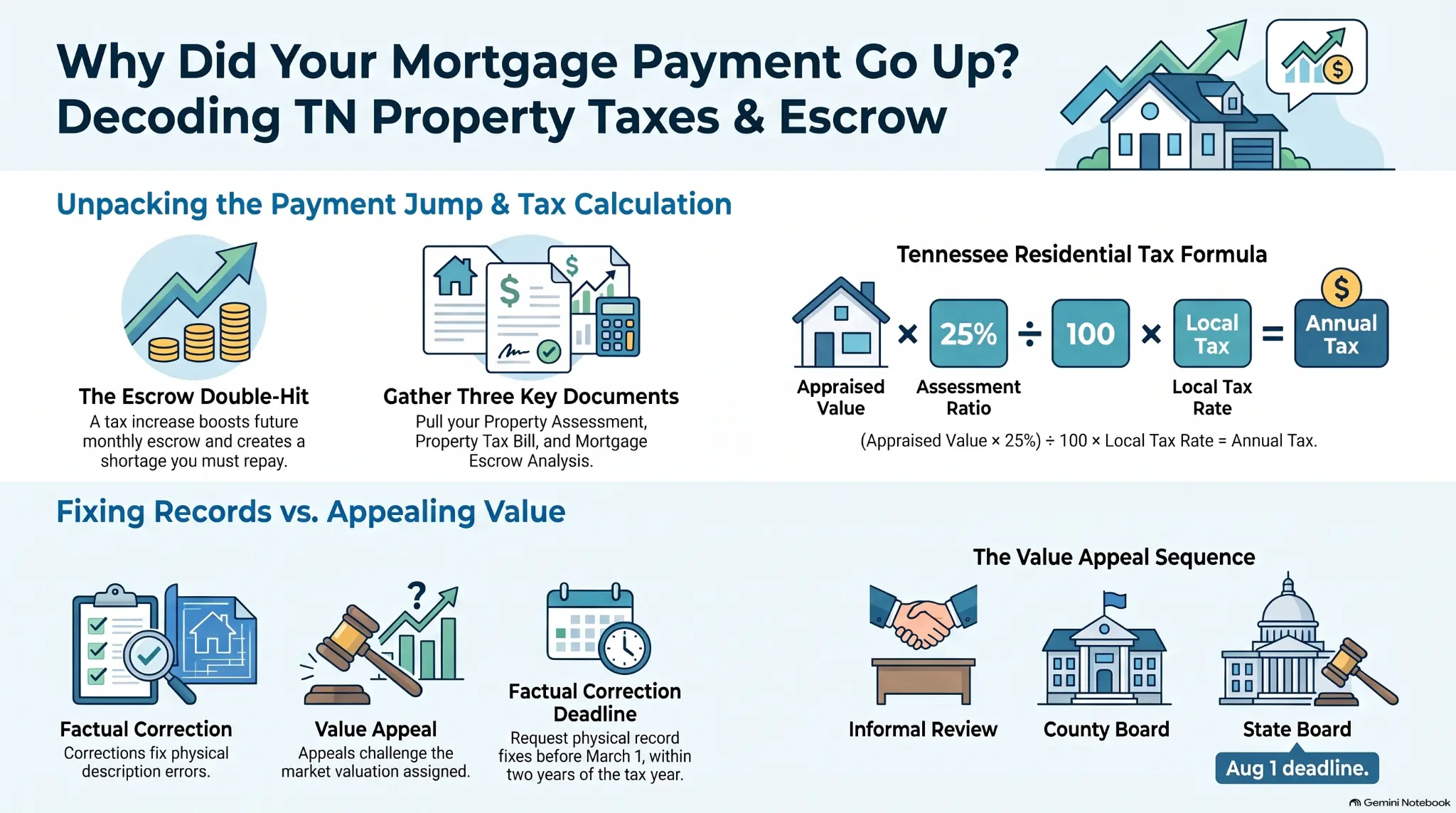
Start with three documents
Pull your property assessment, property tax bill, and mortgage escrow analysis.
The assessment shows the county’s property value and classification. The tax bill applies the adopted tax rate to the assessed value. The escrow analysis shows what the mortgage servicer expects to collect for taxes, insurance, and any shortage.
Each document answers a different question.
An incorrect building measurement belongs with the assessor. A question about the monthly escrow calculation belongs with the mortgage servicer. Identify the discrepancy before making calls.
How Tennessee calculates residential property taxes
For residential property assessed at 25%, the formula is:
Appraised value × 25% ÷ 100 × applicable tax rate.
Here is a hypothetical example, using an assumed rate rather than a current county rate.
Appraised value: $400,000.
Assessed value: $100,000.
Tax rate: $2 per $100 of assessed value.
Annual property tax: $2,000.
The 25% figure is an assessment ratio. You do not pay 25% of your home’s value in property taxes. Include applicable city taxes when calculating your total.
The Tennessee Comptroller explains the calculation here:
https://www.comptroller.tn.gov/office-functions/pa/property-taxes/how-to-figure-your-tax-bill.html
A larger assessment does not mean an identical percentage increase in taxes
The assessor establishes property value and classification. Local elected officials adopt the tax rate.
Tennessee’s certified tax rate process is designed to prevent a countywide reappraisal from creating a revenue windfall by itself, excluding specified changes such as new construction. Local governments follow a separate process to adopt a rate above the certified rate.
Revenue neutrality across a jurisdiction does not guarantee an unchanged bill for each homeowner. Properties appreciate at different rates, changing their share of the tax burden.
An assessment appeal addresses value or classification. The appeal board does not lower the adopted tax rate because you disagree with the budget.
Read the state’s explanation:
Does the county record describe your house?
Before arguing about the value, check the facts used to establish the value.
Review finished square footage, basement classification, bathrooms, garages, outbuildings, pools, acreage, and the building sketch.
A measurement discrepancy deserves a closer look. So does a building recorded on the parcel which no longer exists.
Ask how the assessor defines each category. An MLS listing, appraisal, and county record do not always describe space in the same way.
Then gather evidence. A measured floor plan supports a measurement question. A survey supports an acreage question. Dated photographs help document physical conditions.
I would start with a specific discrepancy and supporting documents. Give the assessor something concrete to evaluate.
Davidson County owners should begin at:
For other counties, start with your assessor’s website or the state property assessment database:
https://assessment.cot.tn.gov/
A factual correction and a value appeal follow different procedures
“The record includes a garage I don’t have” describes a factual issue.
“The county assigned too much value to my garage” disputes valuation.
Tennessee’s correction process covers qualifying errors involving physical descriptions, ownership, location, coding, entry, and transcription. The process does not reopen judgment calls involving finish quality, depreciation, location, or comparable properties.
Qualifying corrections must be requested or initiated before March 1, no later than the second year following the affected tax year. For example, a qualifying error affecting tax year 2025 requires action before March 1, 2027.
Ask the assessor which procedure applies. The correction process is separate from an ordinary market-value appeal.
State correction guidance:
https://comptroller.tn.gov/office-functions/pa/property-taxes/assessment-schedule.html
Also, correcting 10% of the living area does not automatically reduce the entire property value by 10%. Land and other improvements still contribute to the total.
Build an appeal around evidence
A useful appeal identifies the parcel, tax year, county value, requested value, and reasons for the difference.
Support the request with relevant sales, dated photographs, repair estimates, or an existing appraisal.
Nearby does not always mean comparable. Look at size, age, condition, lot, location, and features. Explain why a renovated property differs from a home needing substantial repairs.
Ask which valuation date and sales period apply before paying for a new appraisal. A current refinance appraisal might answer a different question from the assessment under review.
Wilson County’s 2026 guidance, for example, directs owners to use 2025 sales supporting value as of January 1, 2026. Its guidance also identifies repair estimates, photographs, and existing appraisals as potential evidence.
Wilson’s appeal guidance:
https://www.wilsoncountytn.gov/386/Appraisal-Appeal
I would rather present a few relevant comparisons with clear explanations than a stack of unrelated listings.
Protect the appeal deadline
The ordinary sequence is an informal assessor review, a County Board of Equalization appeal, and then a State Board of Equalization appeal.
An informal conversation does not replace a formal filing.
Ask what to submit, where to submit the material, and when the deadline falls. Keep the filing confirmation. Check your county’s current calendar even without a new assessment notice.
For state appeals, the ordinary deadline is August 1 or 45 days after the county-board notice was sent, whichever is later. State appeals involve filing requirements and a fee.
County schedules differ. Use the current instructions for Davidson, Williamson, Rutherford, Wilson, Sumner, or Maury County rather than borrowing a neighboring county’s deadline.
State appeal instructions:
https://comptroller.tn.gov/boards/state-board-of-equalization/value-appeals.html
Check tax assistance separately
Tax relief helps eligible homeowners pay property taxes. A participating jurisdiction’s tax freeze generally holds qualifying taxes at a base amount while the owner continues to qualify.
Neither automatically eliminates the tax bill.
Qualifying older homeowners, homeowners with disabilities, disabled veterans, and certain surviving spouses should ask the trustee’s office about available assistance. Veteran eligibility involves specific requirements beyond a generic disability percentage.
Review ownership, residence, income, benefit limits, and annual renewal requirements with the administering office.
Spring Hill illustrates why location matters. The city crosses Williamson and Maury county lines. County and city programs are separate, and eligibility limits differ by jurisdiction.
State tax relief information:
https://comptroller.tn.gov/office-functions/pa/property-taxes/property-tax-programs/tax-relief.html
Participating tax-freeze jurisdictions and income limits:
Why a $100 tax increase creates a $200 payment increase
A higher future tax bill and an existing escrow shortage are separate amounts.
Consider this hypothetical example:
Annual taxes increase $1,200.
Future monthly tax collection increases $100.
The escrow analysis also identifies a $1,200 shortage.
Repayment over 12 months adds another $100 monthly.
The payment increases $200 during the repayment period, even though the annual tax increase equals $100 monthly.
One portion funds future bills. The other repays the shortage. Paying the shortage does not eliminate the higher ongoing tax cost.
Ask the servicer to explain projected taxes, insurance, the shortage amount, and the repayment period. Federal rules govern escrow calculations and shortage treatment.
Federal escrow rules:
https://www.consumerfinance.gov/rules-policy/regulations/1024/17/
After a reduction, follow through with your servicer
Return to the hypothetical $400,000 home and assumed $2 tax rate.
If the supported value becomes $370,000, the annual tax drops from $2,000 to $1,850. The savings equal $150 annually, or $12.50 monthly.
Those figures illustrate the calculation. A square-footage correction does not guarantee this result.
Obtain the revised tax information and request an escrow review. The next payment still depends on insurance, any remaining shortage, and the complete account calculation.
This is the same budgeting principle buyers should apply before purchasing: evaluate the full housing payment. Relocation buyers need local tax information, and new-construction buyers need to understand what the projected tax amount covers.
Bring the three documents to your payment review
If your Middle Tennessee mortgage payment increased, gather your property assessment, tax bill, and escrow analysis.
Does the property record match your house? Does the tax bill reflect the correct value and rates? How much of the escrow payment funds future bills, and how much repays a shortage?
I’ll help you review the numbers, identify what changed, and determine the next step.
Schedule a review:
Keith Goeringer
Mortgage loan officer serving Franklin, Nashville, and Middle Tennessee