
Buying your next home while you still own your current one is one of the trickiest timing problems in real estate. You spot the right home and you want to make an offer, but most of your money is sitting in the house you already own.
Now you're stuck choosing between bad options. Do you sell first and hope the right home shows up later? Make your offer contingent on selling your current home? Move into temporary housing and move twice? Rush your sale and risk leaving money on the table? Or do you just walk away from the home you really want?
This is the gap a bridge loan is designed to fill.
A bridge loan gives you short-term access to the equity in your current home before it sells, so you can use that equity to help buy your next home. In plain English, a bridge loan lets you buy first and sell second.
Why This Matters
Many homeowners have plenty of equity on paper. The problem is you can't touch that equity until your current home actually sells. So you might be rich in equity but poor in available cash right when it's time to make your next offer.
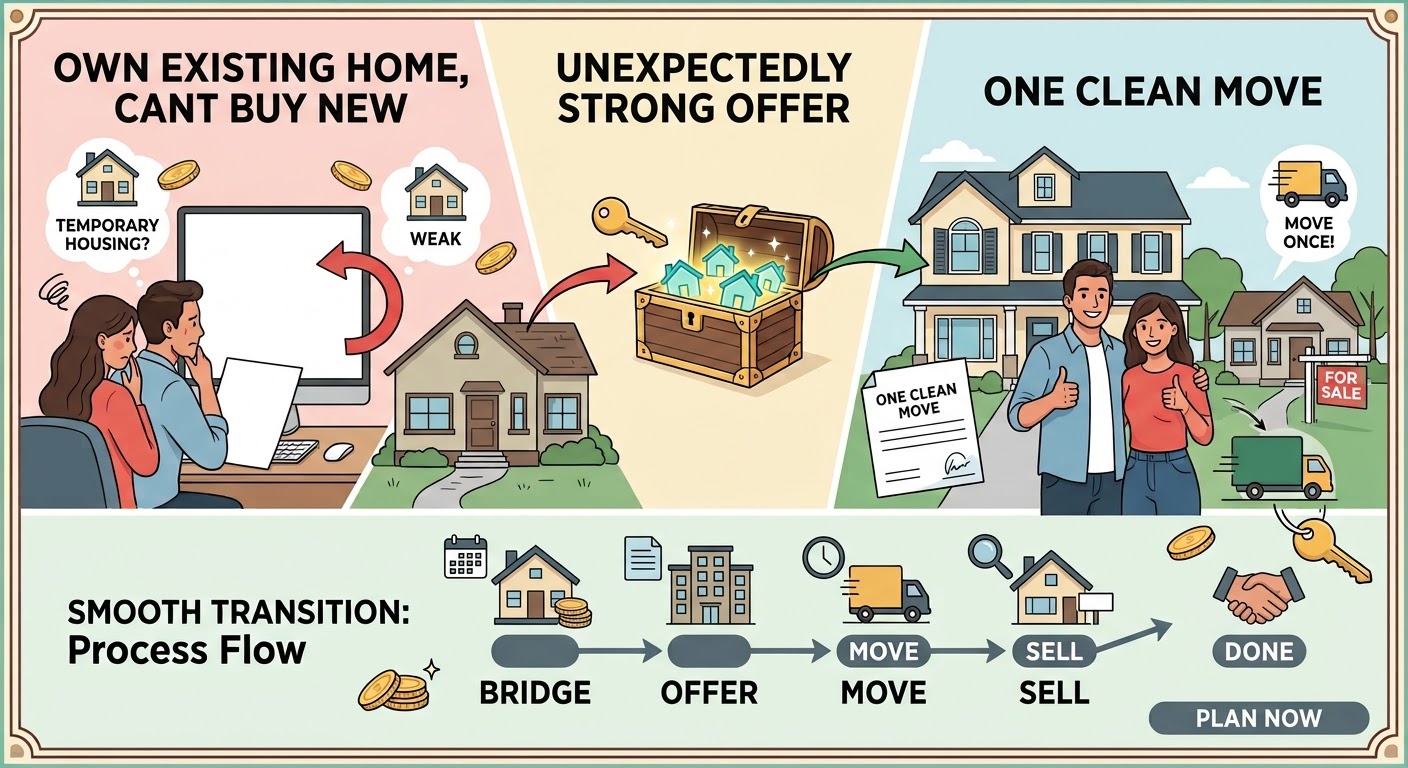
A bridge loan solves that timing problem by unlocking a portion of your equity early. That can help you make a stronger offer, avoid a home-sale contingency, cover your next down payment and closing costs, and move once instead of twice. It also buys you time to properly list and market your current home, get it prepped so it shows better, and avoid rushing into the wrong property.
What Is a Bridge Loan?
A bridge loan is a short-term loan secured by the home you're leaving, often called the departing residence. It taps into your available equity in that property, you use those funds to help purchase your new home, and the bridge loan is typically paid off when your current home sells.
It literally bridges the gap between the home you own now and the one you want to buy next.
How the Process Usually Works
Most bridge loan setups involve two loans: the bridge loan on your current home, which frees up the equity, and the new mortgage on the home you're buying. The bridge unlocks the equity, and the purchase mortgage finances the new home.
Because both loans interact, the lender has to look at the entire picture: your current home's value and mortgage, the new home's price and terms, your income and debts, your credit profile, and your equity and exit plan. The exit plan is usually straightforward. You sell the departing home and use the proceeds to pay off the bridge loan.
How a Bridge Loan Strengthens Your Offer
Sellers care about one thing above all: certainty.
When your offer depends on your home selling first, it adds moving parts and risk for the seller. Your buyer has to close, their inspection has to go well, their appraisal has to work, their financing has to stay on track, and all the timelines have to line up.
A bridge loan can often remove that home-sale contingency entirely. Instead of saying "I need to sell my home first," you may be able to write a clean, non-contingent offer. In a multiple-offer situation, that cleaner offer can be the difference between "accepted" and "sorry, we went with someone else."
No Required Monthly Bridge Payment (On Some Programs)
Some bridge loan programs don't require a monthly payment during the short bridge term. That doesn't mean the loan is free. Interest still accrues, and it's typically settled when your current home sells or when you pay off the bridge loan.
This can help in two ways. First, the bridge payment may not be counted as a monthly obligation while you're qualifying for the new mortgage. Second, your debt-to-income ratio may look better, which can give you more room to qualify.
Common Ways Bridge Funds Can Be Used
Depending on your approval and available equity, bridge loan funds may help with your down payment and closing costs on the new home, closing costs on the bridge loan itself, moving costs, and repairs or touch-ups before listing your current home. Think paint, carpet, or basic updates that help it show better. Some buyers even use a portion for minor updates to the new home before moving in.
Instead of waiting for the sale to close, you can put part of your equity to work now and sell from a stronger, more prepared position.
Who Is a Good Fit for a Bridge Loan?
A bridge loan may be a strong option if you own a home with solid equity, want to buy before you sell, and would rather avoid a home-sale contingency. It fits homeowners who prefer to move once instead of twice, need their current equity for the next purchase, want time to prep and properly list their home, and have a clear plan to sell, backed by income, credit, and equity that support the structure.
This is especially common for move-up buyers who have outgrown their current home, want a different school zone or area, need more space, are relocating, or simply want to secure the next home before putting the current one on the market.
At minimum, a bridge loan gives you an additional option to evaluate before you assume you have to sell first.
Who Is Not a Good Fit?
A bridge loan isn't a magic fix. It probably won't be right if you have little or no equity, your current home may be difficult to sell, or you're already stretched thin on the new payment. It's also not the answer if you don't have a clear plan to list and sell, you're unsure whether you actually want to sell, you need a long-term loan rather than a short-term solution, or you're just not comfortable with temporary financing.
A bridge loan fixes a timing problem. It doesn't fix a weak overall purchase plan. You still need to understand your current mortgage balance, your home's estimated value and likely sale price, expected closing and bridge costs, your new payment, and realistic timelines.
When Should You Start?
Don't wait until you're under contract on the new home to ask about a bridge loan. That's one of the most common mistakes buyers make.
If you think you might buy in the next 30 to 60 days, start the conversation now. The lender will need time to review your equity, your income and debts, your credit, and both properties as part of the overall structure. Starting early gives you a cleaner plan and helps your agent know exactly what kind of offer you can confidently write before you start touring homes seriously.
What You Typically Need to Review a Bridge Loan
To get the ball rolling, you'll usually need:
- Current mortgage statement and estimated payoff amount
- Estimated value of your current home
- Homeowners insurance details and property tax information
- Income documents (pay stubs, W-2s, etc.)
- Asset statements (bank, retirement, etc.)
- A credit review
- Estimated price range and target down payment for the next home
- Your expected listing timeline
If you're self-employed, you may also need business or personal bank statements, tax returns, or other documentation.
The goal is simple: build the plan before you're under pressure.
The Real Benefit
The biggest advantage of a bridge loan is control.
You don't have to sell first and hope the right home appears. You don't have to panic-list your current home before it's ready, move twice, or weaken your offer with a home-sale contingency if you qualify for another route. Instead, you get to see the numbers, understand your options, and make a clear decision.
A bridge loan won't always be the best answer. But you should at least know it exists before making one of the biggest financial moves of your life.
Final Thought
If you own a home with equity and want to buy another, don't automatically assume you must sell first. You may have more options than you think. A bridge loan might help you buy first, sell second, and write a stronger offer on the home you actually want.
The key is timing. Review the numbers early, before you list, before you start serious home shopping, and definitely before you fall in love with a property and have to scramble to solve the financing later.
If you're even thinking about buying before selling, let's run your numbers and see if a bridge loan makes sense for your situation.