
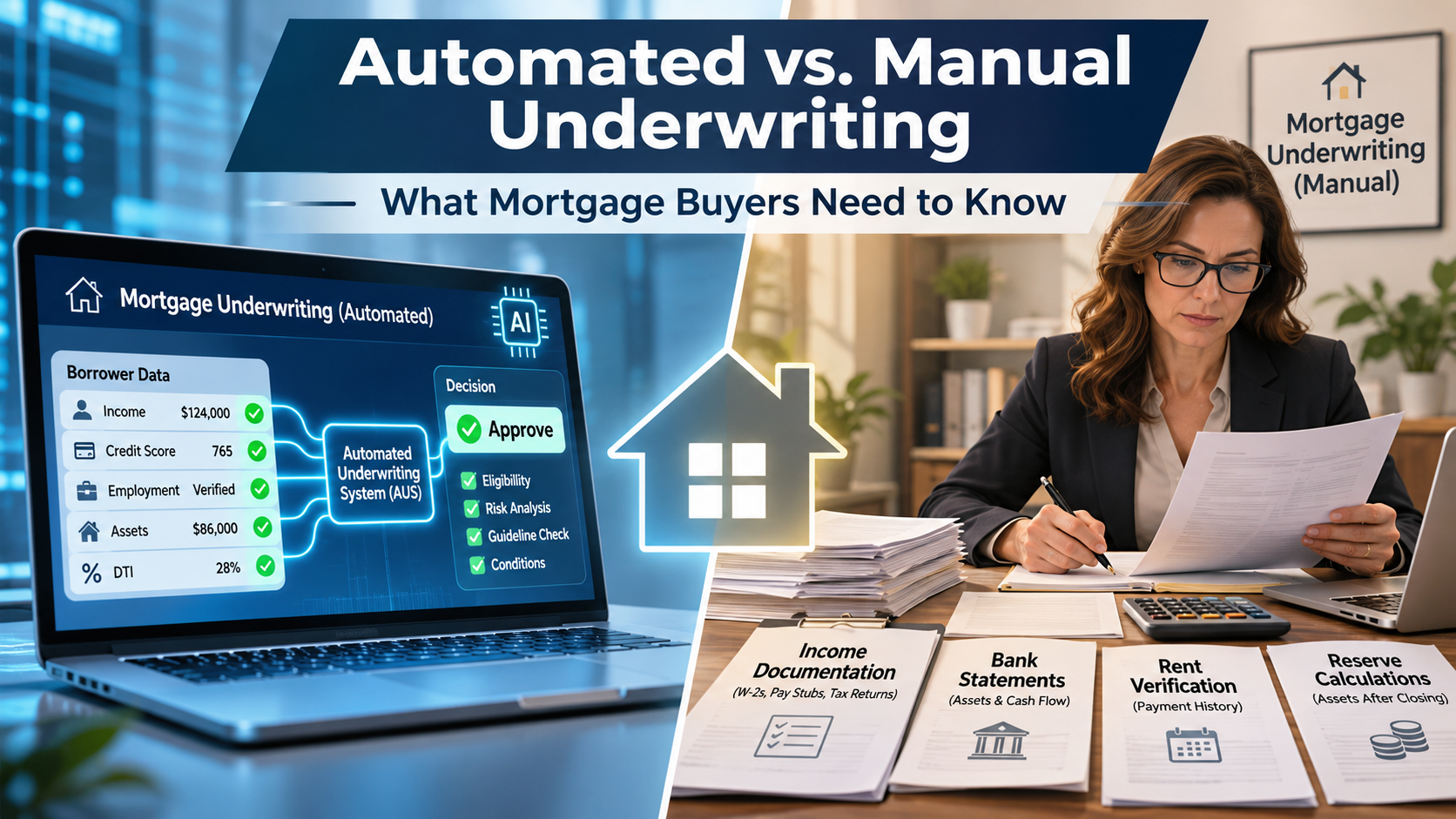
It's called an Automated Underwriting System, or AUS.
And despite what some borrowers believe, the computer doesn't issue your final mortgage approval.
It evaluates the information submitted by your lender and recommends whether the loan meets the program's automated underwriting requirements.
But there's another way to underwrite a mortgage.
It's called manual underwriting.
I've worked in mortgage lending for more than two decades, and I've seen borrowers who couldn't receive an automated approval qualify through manual underwriting.
I've also seen situations where manual underwriting was more difficult than getting an automated approval.
The differences come down to how the loan gets evaluated, the documentation required, and the guidelines each method follows.
Let's go through both.
What Is Automated Mortgage Underwriting?
Automated underwriting is the process lenders use to evaluate mortgage applications through computer-based underwriting systems.
The two major systems are:
- Desktop Underwriter (DU), developed by Fannie Mae.
- Loan Product Advisor (LPA), developed by Freddie Mac.
Lenders also use these systems for certain FHA and VA loans.
When a lender submits a mortgage application, the system evaluates information such as your credit history, qualifying income, monthly debts, available assets, down payment, loan amount, and property details.
The system analyzes those factors together to determine whether the application meets its automated risk and eligibility standards.
This is important because automated underwriting doesn't evaluate every borrower using one fixed debt-to-income ratio.
It evaluates the overall risk profile.
A borrower with stronger credit, significant savings, and a larger down payment might receive an automated approval with a higher debt-to-income ratio than another borrower.
The exact outcome depends on the loan program and the information submitted.
What Does Approve/Eligible Mean?
When a Fannie Mae Desktop Underwriter submission returns Approve/Eligible, the system has determined the loan meets its automated credit-risk standards and applicable eligibility requirements based on the submitted information.
That's an important step toward mortgage approval.
But here's what I want buyers to understand.
Approve/Eligible does not mean your mortgage is completely approved.
Your lender still needs to verify the information, review the required documents, confirm the property's eligibility, and satisfy underwriting conditions.
A borrower might receive an automated approval and later run into problems because their verified income is lower than reported, assets don't meet the requirements, or additional debts change their qualifying ratios.
The automated recommendation is only as reliable as the information submitted.
What Happens When Automated Underwriting Doesn't Approve the Loan?
Automated underwriting systems return several possible recommendations.
Some common Desktop Underwriter findings include:
- Approve/Eligible: The loan meets automated risk and eligibility standards.
- Approve/Ineligible: The credit-risk assessment is acceptable, but an eligibility requirement hasn't been met.
- Refer/Eligible: On FHA or VA submissions, the loan requires manual underwriting review.
- Refer/Ineligible: On FHA or VA submissions, manual review is needed, and the system has identified an eligibility problem.
- Refer with Caution: On conventional submissions, the loan does not meet DU's automated standards.
These findings aren't interchangeable, and they don't all mean the borrower is permanently denied.
Depending on the program and the issue, the lender might correct inaccurate information, change an eligible loan structure, or evaluate the file through manual underwriting.
What Is Manual Mortgage Underwriting?
Manual underwriting means a qualified mortgage underwriter evaluates the borrower's financial information using the applicable manual underwriting guidelines.
Instead of relying on the automated system's credit-risk recommendation, the underwriter performs a more detailed assessment.
They review factors including:
- Credit history and payment patterns
- Employment and income stability
- Existing monthly debts
- Current and previous housing payment history
- Funds available for closing
- Financial reserves remaining after closing
- Compensating factors permitted by the loan program
Manual underwriting is not an exception to mortgage guidelines.
There are specific rules the loan must satisfy.
In many cases, manual underwriting actually has more restrictive debt-to-income requirements and additional documentation requirements.
That's where buyers sometimes get surprised.
The Biggest Differences Between Automated and Manual Underwriting
| Category | Automated underwriting | Manual underwriting |
|---|---|---|
| Risk evaluation | Computer-generated risk recommendation | Human assessment under program rules |
| Debt-to-income | Program-specific automated limits | Often lower, defined limits |
| Rental history | Verification sometimes waived | Greater documentation requirements |
| Reserves | Based on automated findings and program | Often important for qualifying or higher ratios |
| Compensating factors | Evaluated within automated risk assessment | Must meet specific documented standards |
| Final approval | Lender makes final decision | Lender makes final decision |
Both methods require accurate information, and neither guarantees loan approval.
Why Debt-to-Income Ratios Are Different
Your debt-to-income ratio, or DTI, compares your qualifying monthly debt payments with your gross monthly income.
For example, suppose you earn $6,000 per month.
Your proposed housing payment is $2,000, including principal, interest, property taxes, insurance, and applicable HOA fees.
You also have $700 in monthly payments on other debts.
Your total monthly debts are $2,700.
That puts your DTI at 45%.
With automated underwriting, the system evaluates this ratio alongside your other financial information and applicable program standards.
With manual underwriting, specific ratio limits come into play.
FHA manual underwriting
FHA has published manual underwriting limits based on credit scores and acceptable compensating factors.
For borrowers with qualifying credit scores of at least 580, the common frameworks are:
| Housing / total DTI | FHA manual underwriting requirement |
|---|---|
| 31% / 43% | Standard baseline |
| 37% / 47% | One qualifying compensating factor |
| 40% / 40% | No discretionary debt |
| 40% / 50% | Two qualifying compensating factors |
The first number is the housing payment divided by qualifying income.
The second number includes the housing payment plus other qualifying monthly debts.
These limits explain why someone might receive an automated approval at a DTI above 50%, yet fail to qualify through manual underwriting.
Manual underwriting doesn't mean the underwriter has unlimited discretion.
The ratios must fit the program requirements.
Why Rental Payment History Becomes So Important
This is one of the biggest challenges I've encountered with manually underwritten mortgages.
With certain automated underwriting approvals, lenders don't need to separately verify rental payment history.
But FHA manual underwriting generally requires documentation of the borrower's previous 12 months of housing history.
And VA loans receiving an AUS Refer have different requirements, including a 24-month rental history under VA's documentation guidelines.
For FHA manual underwriting, acceptable verification includes a credit report showing housing payment history, verification from an unrelated landlord, or canceled checks covering the required period.
Think about how people pay rent today.
Some pay through apartment management companies.
Others use checks, cash, or informal arrangements with private landlords.
I've worked with borrowers who have been paying rent consistently but don't have the documentation needed for manual underwriting.
Cash rent is particularly difficult when there isn't an acceptable record of those payments.
And when someone rents from a family member, additional documentation concerns arise.
The borrower might have an excellent history of paying their bills.
But the lender still needs documentation meeting the applicable guidelines.
What if you're living rent-free?
Living with family and saving money for a down payment makes financial sense.
But depending on the program, rent-free housing sometimes complicates manual underwriting.
FHA permits borrowers living rent-free. The lender must document the arrangement, including how long the borrower has lived there.
But FHA also recognizes a minimal increase in housing payment as a potential compensating factor.
To use that factor, the borrower must have an acceptable documented housing payment history, and the proposed payment increase must fall within FHA's limits.
Someone paying no rent cannot satisfy the requirement for a minimal increase in an existing housing payment.
And some lenders have additional requirements, commonly called overlays, which further restrict manual underwriting for borrowers without established rental payment histories.
This is why I ask borrowers about their current housing arrangements early in the mortgage process.
The way you pay rent, and whether you can document those payments, sometimes affects which underwriting options are available.
What Are Mortgage Reserves, and Why Do They Matter?
Reserves are qualifying funds remaining after your down payment and closing costs.
They provide additional financial support in case you experience unexpected expenses or an interruption in income.
For example, suppose you're buying a house in Spring Hill with a total monthly mortgage payment of $2,500.
If a loan requires three months of reserves, you'll need $7,500 in eligible funds remaining after closing.
That's separate from your down payment and closing costs.
FHA manual underwriting permits documented reserves to serve as a compensating factor for borrowers with higher debt-to-income ratios.
The reserve amounts for this FHA compensating factor are:
- Three total monthly mortgage payments for one- and two-unit properties.
- Six total monthly mortgage payments for three- and four-unit properties.
Not every FHA manually underwritten borrower needs three months of reserves.
The requirement depends on the borrower's qualifying ratios, compensating factors, and any additional lender requirements.
This is a significant distinction from automated underwriting, where the system might approve an eligible borrower without requiring those same reserves.
A borrower might have enough money to close but not enough remaining afterward to use reserves as a compensating factor.
And that changes the manual underwriting calculation.
What Are Compensating Factors?
A compensating factor is a documented financial strength the underwriting guidelines permit a lender to consider when evaluating certain higher-risk characteristics of a mortgage application.
For FHA manual underwriting, qualifying compensating factors include:
- Documented financial reserves.
- A minimal increase from the current housing payment to the proposed mortgage payment.
- Qualifying residual income.
- Certain additional income not included in qualifying income.
FHA also has a separate qualifying ratio framework for borrowers without discretionary debt.
For example, a borrower with a 45% total DTI might qualify within the 37/47 framework if they have an acceptable compensating factor and meet the other applicable requirements.
Another borrower with the same DTI might fail manual underwriting because they don't have an acceptable compensating factor.
The DTI number alone doesn't tell us whether the loan qualifies.
We have to evaluate the entire file.
Are FHA, VA, and Conventional Manual Underwriting the Same?
No. This distinction matters.
FHA loans
FHA manual underwriting follows specific credit, housing history, debt-to-income, and compensating-factor requirements.
The 31/43, 37/47, and 40/50 ratios discussed earlier apply to certain FHA manually underwritten loans.
VA loans
VA underwriting places substantial emphasis on residual income.
Residual income measures the income remaining after deducting qualifying expenses, including the proposed housing payment, other debts, taxes, and certain family living expenses.
VA uses 41% as a DTI benchmark requiring additional scrutiny under specified conditions, rather than treating 41% as a universal maximum.
VA manual underwriting also involves rental history verification and credit evaluation.
The specific reserve requirements differ from FHA.
Conventional loans
Fannie Mae permits manual underwriting for eligible conventional mortgages.
Its general maximum DTI for manually underwritten loans is 36%, increasing to 45% when the borrower meets the applicable credit score and reserve requirements.
For loans evaluated through Desktop Underwriter, the general maximum is 50%.
Some conventional products and transaction types have additional restrictions.
The important point is that manual underwriting is not one universal mortgage program.
The requirements depend on the loan type.
Why One Lender Might Approve a Loan Another Lender Rejected
Mortgage lenders don't all operate under identical lending policies.
FHA, VA, Fannie Mae, and Freddie Mac publish program guidelines.
Individual lenders also establish policies determining which loans they're willing to originate.
These additional restrictions are called lender overlays.
For example, a mortgage program might permit manual underwriting, but a lender might choose not to offer manually underwritten loans.
Another lender might offer manual underwriting but require a higher credit score, additional reserves, or a documented rental payment history beyond the program's minimum standard.
The underlying program guidelines haven't necessarily changed.
The lender's policies are different.
This explains why a borrower sometimes receives different answers from different lenders.
But a second lender still has to document eligibility under the applicable program and its own policies.
Manual underwriting isn't permission to ignore the rules.
How I Approach Automated and Manual Underwriting
When I review a mortgage application, I want the information going into the underwriting system to be accurate.
That's why I use what I call a deep application.
I go through the application with the borrower, verify the information, and review income and asset documentation before relying on automated underwriting findings.
There's a reason for this.
Online applications aren't always completed correctly.
Income might be entered incorrectly. Debts might be missing or calculated differently than underwriting requires. Available assets might not be properly documented.
Those differences affect the actual debt-to-income ratio and underwriting recommendation.
Once we've verified the information, we have a better understanding of the borrower's options.
If automated underwriting doesn't return an approval, I want to understand why.
Then we evaluate whether the applicable mortgage program and lender permit manual underwriting.
I've worked with borrowers who didn't receive an automated approval but had another qualifying path through manual underwriting.
The two issues I frequently encounter are rental payment documentation and financial reserves.
Sometimes those become bigger obstacles than the borrower's credit score.
That's why I believe borrowers and Realtors need to understand the differences before assuming a loan is approved or denied.
Does an Automated Underwriting Rejection Mean You Can't Buy a House?
No. Not necessarily.
But it doesn't mean manual underwriting will solve the problem either.
An automated rejection tells us the loan didn't satisfy the automated system's requirements based on the submitted information.
The next step is determining why.
Sometimes the information needs correcting.
Sometimes the borrower needs to reduce debts or document additional qualifying income.
Sometimes manual underwriting is available.
Other times, the borrower needs more savings, better credit history, or a longer documented housing payment history.
The answer depends on the borrower, loan program, property, and lender.
If you're buying a home in Franklin, Nashville, Brentwood, Spring Hill, Columbia, Murfreesboro, or the surrounding Middle Tennessee communities, understanding your underwriting options before making an offer is worth the conversation.
And if you're a Realtor working with a buyer who hasn't received an automated approval, don't assume the transaction is finished.
Let's review the underwriting findings, qualifying numbers, and available options.
A mortgage rejection should come with an explanation, not simply a no.
Keith Goeringer
Mortgage Loan Officer
Franklin, Tennessee