I bought a house for $450,000. Today, it’s worth approximately $900,000.
Years ago, I purchased a home for $450,000.
I put 5% down, approximately $22,500, using money borrowed from my 401(k).
That was my primary residence.
Fast-forward roughly ten years, and the property is now worth approximately $900,000.
That’s about $450,000 in appreciation, before accounting for improvements, selling expenses, and other ownership costs.
But here’s the important part.
I didn’t sell the property when I moved.
I kept it.
Today, it’s a rental property with a low-interest-rate mortgage.
When we purchased our current primary residence, I also used a home equity line of credit on another property to help fund the down payment.
I’ve used both 401(k) loans and home equity financing in my own real estate decisions.
Looking back, if I’d sold my properties every time I wanted to move, I wouldn’t have anywhere near the equity I have today.
Now, I’m not suggesting you’ll experience the same appreciation. My property benefited from what happened in its particular market over those years.
But my experience changed how I look at the decision to sell a home.
I don’t automatically see a house as something you need to get rid of to buy the next one.
Sometimes keeping the property deserves a serious look.
Your 3% mortgage might be worth more than you realize
Let’s say you bought a house in Franklin, Spring Hill, Columbia, or another part of Middle Tennessee several years ago.
You locked in a 3% mortgage.
Your monthly payment, including principal, interest, property taxes, insurance, and HOA dues, is $1,650.
Now you want to buy another house.
Here’s the first question I’d ask.
What would your current home rent for?
Let’s say comparable homes in your neighborhood are renting for $2,500 a month.
That’s $850 more than your existing housing payment.
Of course, you don’t get to keep all $850.
You need to budget for maintenance, vacancies, repairs, and possibly property management.
Let’s estimate another $350 monthly for those expenses.
That leaves approximately $500 in monthly cash flow.
Now you’ve got a property potentially generating $6,000 a year before income taxes and unexpected expenses beyond your budget.
You also still own the property.
And every month, part of your mortgage payment goes toward reducing your loan balance.
That’s what I want homeowners to look at.
Not simply what their house is worth today, but what keeping it might mean over time.
The part that surprises people: What could those homes be worth at retirement?
I’ve done Zoom presentations with 50 or 60 homebuyers at a time, showing them how their mortgage and real estate decisions might affect their financial future.
What surprises people is often the long-term equity projections.
We have software that allows us to look at the historical appreciation of homes in specific neighborhoods.
We examine comparable properties and different historical periods, including five-year, ten-year, and much longer periods going back decades.
Then we build projections showing what the property might be worth in the future.
We can look at five years, ten years, twenty years, or all the way into retirement.
And we can model what happens when you own two, three, or even four properties instead of one.
Think about what happens over time.
Your tenants help cover the mortgage payments.
The loan principal gradually declines.
Rental income might increase as market rents change.
And if the property appreciates, your equity grows from both the increase in value and the reduction in what you owe.
I call attention to the velocity of equity, or how equity might accumulate across multiple properties over time.
Of course, appreciation isn’t guaranteed. Home values sometimes decline, rents don’t always increase, and expenses rise.
That’s why we show different scenarios instead of assuming the best-case outcome.
But I want people to see the possibilities before making a decision involving hundreds of thousands of dollars.
What happens when the rental mortgage is paid off?
This is another conversation I enjoy having with homeowners.
Let’s say you keep your existing house and rent it out.
Over the years, the mortgage balance gets smaller.
You might even decide to make one extra principal payment each year.
Our software lets us model what those additional payments might do to the mortgage balance and payoff date.
Now fast-forward to retirement.
What if the rental property is paid off?
You still have property taxes, insurance, maintenance, and other ownership expenses. But you no longer have the regular principal and interest mortgage payment.
That might leave you with substantially more monthly rental income.
And you still own the house.
You have options.
You might keep the rental income as part of your retirement plan.
You might sell the property and invest the proceeds.
You might explore borrowing against the property’s equity, depending on your financial situation and available loan programs.
Or you might work with an estate planning attorney and financial advisor on how to eventually leave the property to your children.
There’s no guarantee one choice will outperform another.
We can even compare what happens if you sell the property today and invest the proceeds instead, or borrow against equity to invest. Borrowing to invest introduces additional risk and costs, so we include those in the comparison.
The point is to understand your options.
But does the rental income really cover the costs?
This is where I want you to be careful.
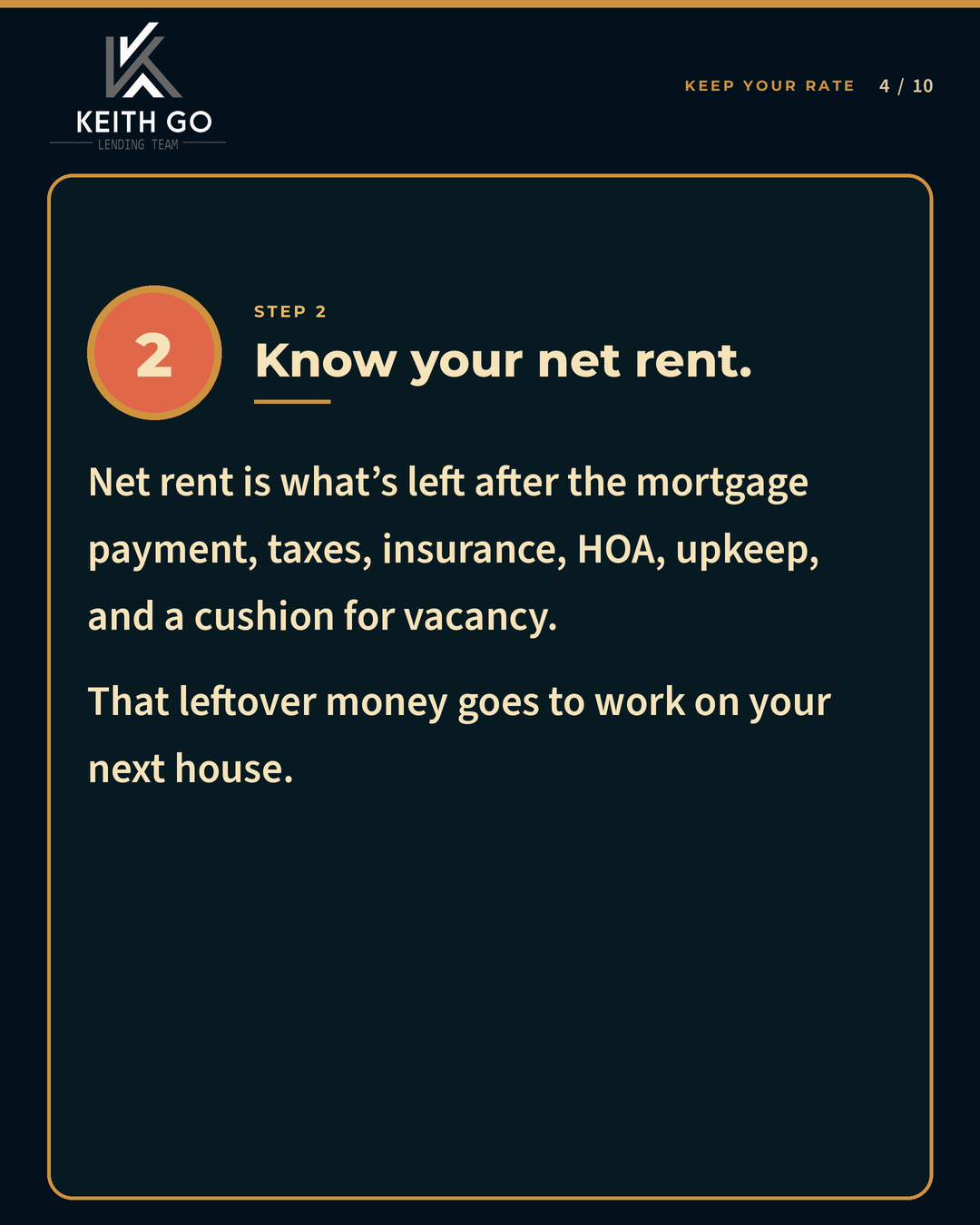
There’s a difference between the rent you collect and the money you keep.
If your property rents for $2,500, don’t assume you have $2,500 available to help pay for your next home.
We need to account for the existing mortgage, taxes, insurance, HOA dues, maintenance, vacancies, and any additional financing on the rental.
For example:
| Monthly rental example | Amount |
|---|
| Rental income | $2,500 |
|---|
| Existing mortgage, taxes, insurance, HOA | -$1,650 |
|---|
| Estimated additional rental expenses | -$350 |
|---|
| Estimated net monthly cash flow | $500 |
|---|
That $500 is the number I’d want to start with.
And remember, we’re estimating. A roof replacement, a vacant month, or an expensive repair affects your results.
That’s why I don’t recommend going into this strategy without reserves.
My preferred target is six months of reserves.
I’ve owned rental properties long enough to know that water heaters break. Windows need replacing. Air conditioners eventually quit.
You don’t want to be depending on every dollar of rental income to make your next mortgage payment.
I want you building equity without worrying about how you’re going to pay for the next repair.
Do you have to manage the rental yourself?
Not necessarily.
We’ve typically managed our nearby rental properties ourselves.
But we’ve also used property management companies for properties farther away, and our experiences have been excellent.
If you don’t want to handle tenants, maintenance calls, and collecting rent, property management might be worth the expense.
We simply need to include the management fee when calculating your expected cash flow.
Can you qualify for another mortgage while keeping your current home?
Yes, depending on your income, debts, available assets, and loan program.
And this is something I want homeowners to understand.
Just because you’re keeping your current mortgage doesn’t mean you automatically have to qualify as if the property produces no income.
For eligible conventional loans, lenders have rules for considering rental income from a home you’re converting from your primary residence into a rental.
Fannie Mae updated these rules in September 2026.
Under its departing-residence guidelines, lenders generally use 75% of documented market rent and compare that amount with the existing property’s principal, interest, taxes, insurance, and HOA dues.
A positive result helps offset the current property’s housing expense for qualification. It doesn’t become additional income you can use to qualify for a larger mortgage.
For example, if supported market rent is $2,500, the lender starts with $1,875.
If your current property’s full housing payment is $1,650, the calculation produces a positive $225.
Under these rules, that amount helps offset the existing property obligation.
The updated guidelines also allow eligible market rents to be documented without a signed tenant lease. Other loan programs have different requirements.
This is separate from our cash-flow calculation above.
One calculation tells us how much money the rental might generate.
The other tells us how the lender evaluates the property when approving your new mortgage.
Both matter.
That’s why I want to review your complete situation before you start shopping.
Where do you get the down payment for your next house?
This is one of the biggest obstacles I see.
Sometimes homeowners have plenty of equity but not enough accessible cash.
Other times, they have the down payment but very little money left for reserves.
I want to solve both issues before recommending the next purchase.
First, let’s look at money you already have
One option I like reviewing is a 401(k) loan, if your retirement plan allows it.
I’ve used this strategy personally.
When I purchased my $450,000 home, I borrowed the 5% down payment from my 401(k).
I sometimes explain this as becoming your own bank.
With a qualifying retirement plan loan, your repayments, including interest, generally go back into your retirement account.
You’re still borrowing money, though. The loan has repayment requirements, your invested balance changes, and leaving your employer might create additional consequences.
It isn’t free money, and it isn’t the best choice for everyone.
But I think it’s worth comparing with other financing options.
Next, let’s look at your home equity
A HELOC, or home equity line of credit, might provide another way to access funds without selling the property.
I used a HELOC on another property when buying the home we’re in now.
There are different HELOC structures available, including products with varying payment and repayment terms.
Some products offer lower initial payments but allow balances to increase when payments don’t cover the interest charged. Those deserve careful review because the debt can grow.
We compare the rate, required payment, repayment terms, available equity, and how the additional debt affects your overall finances.
Timing matters too. Some home equity programs restrict borrowing against properties that are being converted to rentals.
The strategy needs to fit the property, your available equity, and the lender’s rules.
What if you don’t have enough equity?
Then we have to evaluate the rest of your finances.
Someone who recently purchased their home might not have enough equity to access the down payment they need.
That doesn’t automatically mean the entire strategy is impossible, but it might make selling the better choice.
We also have to account for closing costs and any reserve requirements.
A 5% down payment is one possible scenario for an eligible conventional primary residence purchase, not a requirement for every borrower or loan program.
The goal isn’t to find a way to borrow every dollar available.
The goal is to structure a purchase you’re comfortable maintaining.
What about getting a lower rate on the next house?
Once we know what you’re comfortable spending, we look at the new mortgage.
And I want you to understand something.
I don’t start by asking how much house you can qualify for.
I start by asking what monthly payment you’re comfortable making.
Then we look at whether net rental income from your existing property helps reduce your combined monthly housing expense.
We also review what’s happening in the local real estate market.
Depending on the home and the negotiation, sellers might be willing to contribute toward closing costs or an interest rate buydown.
We look at temporary and permanent buydowns.
A temporary buydown reduces what you pay during the initial years, but it doesn’t change the full note rate. Eventually, you make the regular payment.
A permanent buydown uses discount points to obtain a lower note rate.
We compare the costs, savings, and how long you expect to keep the new mortgage.
And we work with your Realtor to evaluate what the seller might realistically agree to.
I want you comfortable with the full payment, even after a temporary buydown ends.
That’s particularly important when you’re maintaining another property.
What would your new monthly housing expense look like?
Let’s put the two properties together.
Suppose the total payment on your next home is $3,200 a month.
Your existing rental generates an estimated $500 in monthly cash flow after expenses.
That gives you an estimated combined net housing expense of $2,700 a month.
You’re still responsible for the full mortgage payments and property expenses on both homes.
But the rental income helps offset part of your overall cost.
If the rental has a vacant month, the calculation changes.
If rental income increases, your cash flow might improve.
If property expenses go up, your cash flow might decrease.
The important thing is knowing what those scenarios look like before you buy.
That’s why I like running different numbers instead of giving you one payment and sending you house shopping.
Should you sell your current home or keep it?
I believe people sometimes make a mistake waiting for the perfect house or the perfect interest rate.
I’ve watched homeowners put major decisions on hold because they hope rates will drop.
But what happens if they wait several years and home prices increase?
What happens to the equity they might have built during that time?
Of course, prices don’t always rise. Waiting might be the right financial decision for some buyers.
That’s why I don’t want you buying or selling based on predictions.
I want to show you the numbers.
When I meet with homeowners, we can compare keeping the property, selling and investing the proceeds, or using available equity as part of a broader financial plan.
We can project different future dates, including retirement, using historical appreciation and investment assumptions.
And when it comes to the rental itself, my recommendation starts with the basics.
What will the house realistically rent for?
What are the expenses?
What is the actual net rental income?
Do you have adequate reserves?
Does the new mortgage payment fit your budget?
If the numbers work, we can explore keeping the property.
If the numbers don’t work, I’ll tell you.
I’ve personally benefited from keeping real estate, but that doesn’t mean everyone should become a landlord.
Before you sell your low-rate home, let’s do the math
If you own a house with a 2% or 3% mortgage and you’re thinking about moving, here’s what I’d recommend.
Start by looking at comparable rental properties in your neighborhood.
Find out what your home might rent for.
Then let’s review the mortgage, your available equity, the potential rental income, and what a new home would cost.
I’ll also show you what owning both properties might mean over time.
We can look at five years, ten years, twenty years, or retirement.
You might decide keeping your current home is one of the better financial decisions available to you.
Or you might decide selling is the better path.
Either way, you’ll be making the decision with the numbers in front of you.
Before you give up that low mortgage rate, at least let me show you the math.
Visit KeithGo.com or email me at keith@keithgo.com to review your situation.
⸻
Frequently Asked Questions
Do I have to sell my house to buy another one?
No. Depending on your financial situation and mortgage eligibility, you might purchase another primary residence while keeping your existing home as a rental.
Can rental income help me qualify for the new mortgage?
Yes, under eligible loan programs. The amount recognized by your lender might differ from the actual rent you collect. Fannie Mae’s September 2026 departing-residence guidelines use documented market rent, an adjustment for vacancy and maintenance, and the existing property’s housing payment.
Do I need 20% down for my next home?
Not necessarily. Some primary residence loan programs allow smaller down payments, depending on eligibility. Your financing options also depend on how much money you’ll have available for closing costs and reserves.
Can I use a 401(k) loan for the down payment?
Some retirement plans allow qualifying loans, and certain mortgage programs accept properly documented proceeds as a down payment source. You need to review the retirement plan’s terms and the financial tradeoffs.
What happens if my rental property loses money?
You’ll need to cover the shortfall. Vacancies, repairs, and unexpected expenses are part of rental ownership. That’s why I prefer homeowners to have six months of reserves before taking on another property.
What happens if I keep the rental until retirement?
You might benefit from mortgage principal reduction, rental income, and property appreciation. But home values, rents, maintenance costs, and future returns are uncertain. We can compare different scenarios using projection software.
Is it better to keep my home or sell and invest the equity?
The answer depends on your property, expected rental income, mortgage terms, investment alternatives, taxes, and financial goals. I prefer showing the different scenarios rather than assuming one approach is always better.
⸻
Keith Goeringer
NMLS #488023
Barrett Financial Group NMLS #181106
Equal Housing Opportunity
keith@keithgo.com