Half Off. That Is What This Program Offers.
The federal government owns thousands of foreclosed homes across the country. Most of them get sold through the standard HUD process at market-adjacent prices. But for a specific group of buyers -- teachers, firefighters, law enforcement officers, and emergency medical technicians -- HUD offers something different: 50% off the list price.
Not 5%. Not a $10,000 grant. Fifty percent off the purchase price of the home.
On a $200,000 home, that means you're buying at $100,000. On a $300,000 home, you're in at $150,000. The math is straightforward, and the program has been running for years. Most people who qualify for it have never heard of it.
That's what this post is about.
Who Qualifies
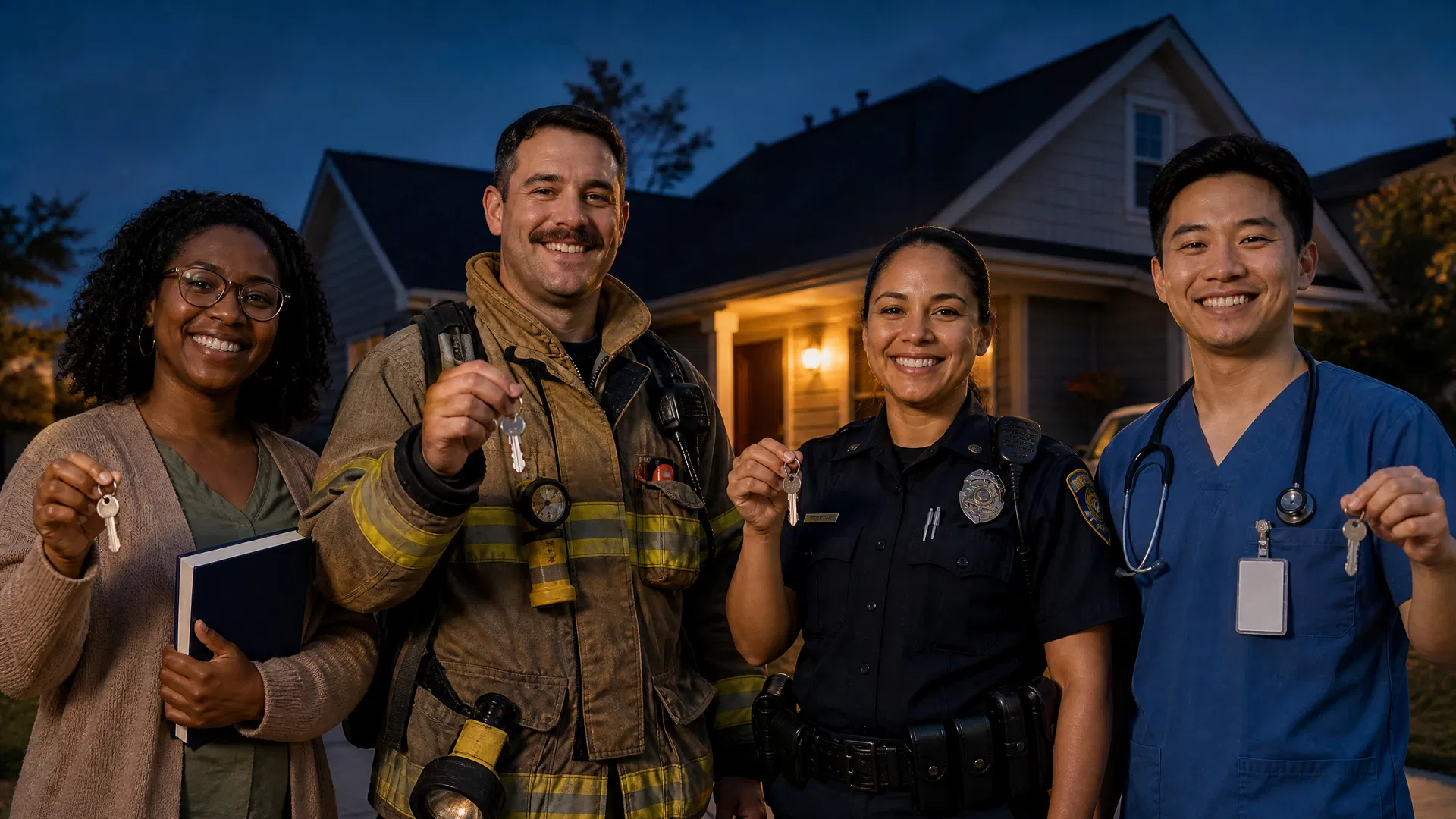
The program is called Good Neighbor Next Door, and HUD designed it specifically for people who serve their communities and often can't afford to live in the neighborhoods where they work. The four eligible professions are:
Teachers: You must be employed full-time by a state-accredited public or private school teaching grades pre-kindergarten through 12. The school must serve students from the area where the home is located. Administrators, coaches, and other school staff do not qualify -- it has to be a classroom teacher.
Law enforcement officers: You must work full-time for a federal, state, local, or tribal law enforcement agency. You must be sworn to uphold and make arrests for violations of the law, and your agency must serve the area where the home is located.
Firefighters: You must be employed full-time by a government-backed fire department -- federal, state, local, or tribal -- and serve the area where the home is located. Volunteer firefighters do not qualify.
Emergency medical technicians: You must work full-time for an emergency medical services unit of a government agency and serve the area where the home is located. This includes paramedics and first responders in qualifying roles.
In all cases, you need to be a full-time employee. Part-time workers and volunteers are not eligible.
The Other Requirements
Beyond your profession, there are a few more boxes to check:
You cannot have owned or purchased a home within the 12 months before you make your offer. This is different from THDA and The Housing Fund, which have no prior ownership restrictions. GNND does have one.
You can only use the program once. If you've participated before, you're not eligible again.
The home must be your primary residence. You cannot use this program to buy a rental property or a vacation home.
You must certify that you plan to remain employed in your qualifying profession for at least 12 months after closing.
There is no income limit and no credit score requirement from the program itself -- those come from whatever mortgage you use to finance the purchase.
How the Discount Actually Works
When you buy a Good Neighbor Next Door home, you pay 50% of the list price. HUD takes the other 50% and places it as a second mortgage on the property. That second mortgage has no interest and no monthly payments. You don't pay it. You don't service it. It just sits there.
After you have lived in the home for three years as your primary residence -- and returned your annual occupancy certifications to HUD each year -- the second mortgage is forgiven completely. HUD releases it, files the satisfaction with your county recorder, and you're done. The discount is yours permanently.
If you leave before the three years are up, you owe back a prorated portion of the discount. The amount decreases over time -- the longer you stay, the less you'd owe if you had to leave early. After month 36, you owe nothing.
HUD takes the annual certifications seriously. They mail them to you around the anniversary of your purchase. You sign, date, and return them. If you don't return them, HUD sends investigators to verify occupancy. Falsifying the certification is a felony. The program is built on the assumption that you're actually living in the home, and HUD enforces that.
The $100 Down Option
If you use an FHA loan to buy a Good Neighbor Next Door home, your required down payment can be reduced to $100.
This is the same $100 Down program covered in the previous post on HUD homes. When you combine it with Good Neighbor Next Door, you're buying at 50% off list price and putting down $100. On a $200,000 home listed at $200,000, you're purchasing at $100,000 with $100 down. Your loan is $99,900.
To get the $100 down, you need to qualify for FHA financing: 580 minimum credit score, stable income and employment, and a debt-to-income ratio that works under FHA guidelines. The FHA loan also comes with mortgage insurance -- both an upfront premium and a monthly premium -- which adds to your monthly payment.
You can also use conventional financing, VA loans, or USDA loans with the Good Neighbor Next Door program. The $100 down is specific to FHA. With other loan types, the standard down payment requirements for that loan apply.
What "Revitalization Area" Means
Not every HUD home qualifies for Good Neighbor Next Door. Only homes in HUD-designated revitalization areas are eligible. These are neighborhoods where homeownership rates and income levels are below the regional average -- areas where HUD has determined that getting owner-occupants into homes would have a meaningful community impact.
In Tennessee, revitalization areas exist in various parts of the state. The specific neighborhoods change over time as HUD updates its designations. The only way to know whether a particular property qualifies is to check the listing on hudhomestore.gov.
This is also why the inventory is limited. You're not shopping from the full HUD catalog -- only the subset of properties that are both in revitalization areas and eligible for the program.
The Seven-Day Window
Here's the part that catches people off guard: Good Neighbor Next Door homes are only listed for seven days.
When a property becomes available, HUD posts it on hudhomestore.gov for one week. During that window, eligible buyers submit bids through a HUD-registered real estate agent. If more than one eligible buyer bids on the same property, HUD selects the winner by random lottery. It's not a highest-bid situation -- it's a lottery among qualifying bidders.
After the seven-day window closes, if no acceptable offer came in, HUD may relist the property or move it to the standard HUD sales process.
The practical implication: you need to be ready before you find the home. That means pre-approved for financing, working with a HUD-registered agent, and checking the listings regularly. If you wait until you find a property you like to start the pre-approval process, you'll miss the window.
Closing Costs and Earnest Money
The 50% discount and the $100 down cover the purchase price and down payment. Closing costs are separate.
When your bid is accepted, you'll need to submit an earnest money deposit within two business days. The deposit is 1% of the list price, with a minimum of $500 and a maximum of $2,000. This needs to be a cashier's check, certified check, or money order.
Closing costs on an FHA purchase typically run 2% to 4% of the loan amount. On a $100,000 loan (50% of a $200,000 home), that's $2,000 to $4,000. HUD does not provide a selling allowance on Good Neighbor Next Door properties the way it sometimes does on standard HUD listings, so you need to plan for closing costs out of pocket or negotiate with your lender on how to structure them.
If the home needs repairs, HUD may give you up to six months to complete them before you move in and start the three-year clock. You can also use an FHA 203(k) rehabilitation loan to roll the purchase price and repair costs into a single mortgage if the property needs significant work.
How to Get Started
The process is similar to the standard HUD home purchase covered in the previous post, with a few differences specific to this program.
First, confirm you qualify. Check your profession against the eligibility requirements and make sure you haven't owned a home in the past 12 months.
Second, get pre-approved for financing. If you want the $100 down option, you need an FHA pre-approval from an FHA-approved lender. I can help with that.
Third, find a HUD-registered real estate agent who has experience with Good Neighbor Next Door specifically. Not every HUD-registered agent has done these deals. The seven-day window and lottery process are different from a standard purchase, and you want someone who knows how it works.
Fourth, check hudhomestore.gov regularly for listings in Tennessee. Look under the Good Neighbor Next Door tab. Set up alerts if your agent can do that for you.
Fifth, when you find a property, move quickly. Your agent submits the bid. If you win the lottery, you complete the paperwork and pay the earnest money deposit within two business days.
If you're a teacher, firefighter, law enforcement officer, or EMT in Tennessee and you haven't looked into this program, it's worth 20 minutes of your time. The inventory is limited and the timing is tight, but the math on a 50% discount is hard to argue with.
Reach out if you want to talk through whether this could work for your situation. We can check the current listings together and run the numbers.
The Bottom Line
The Good Neighbor Next Door program is the most generous homeownership benefit available to public servants in this country, and most people who qualify don't know it exists. A 50% discount on a home purchase is not a small thing. Combined with an FHA loan and the $100 down option, the upfront cost of buying a home drops to nearly nothing for eligible buyers.
The tradeoffs are real: limited inventory, a seven-day bidding window, a three-year residency commitment, and annual certifications. But for the right buyer in the right situation, this program can change the math on homeownership entirely.
If you've been reading this series -- THDA, The Housing Fund, and HUD $100 Down -- this is the fourth program. They each serve different buyers. The right one depends on your profession, your credit score, your income, and what kind of home you're buying. Sometimes the answer is one program. Sometimes it's a combination. The conversation usually takes about 10 minutes.