
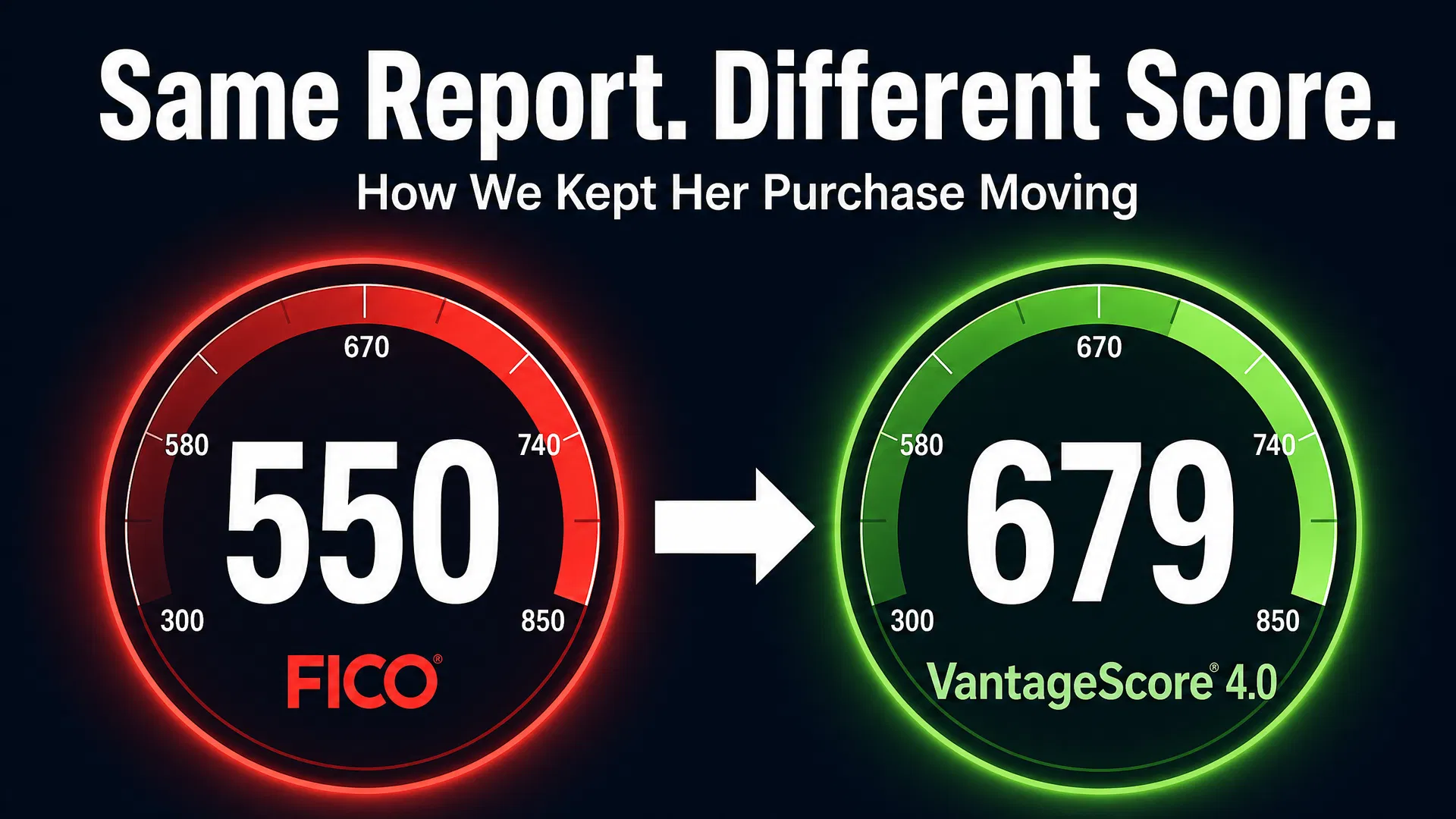
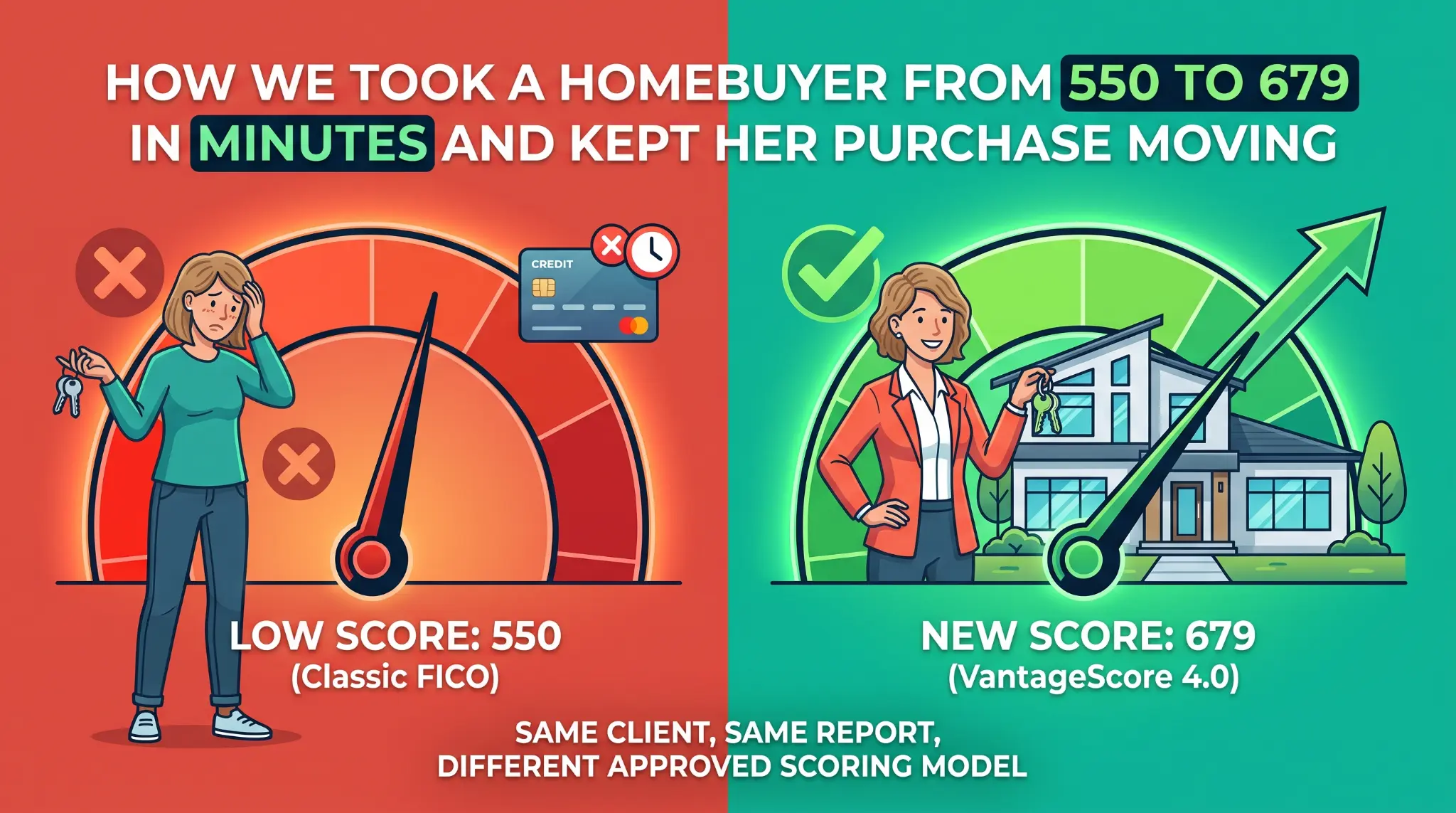
A recent late payment dropped our client's qualifying mortgage credit score to 550.
Minutes later, we had a qualifying score of 679.
We did not pay down a credit card.
We did not complete a rapid rescore.
We did not wait several weeks for the creditor to correct its reporting.
We did not remove the late payment.
We used a different approved credit scoring model.
That 129-point difference allowed our client to keep moving forward with a conventional home purchase using 10% down.
Here is what happened.
A credit score is not a fact about your buyer. It is an opinion -- produced by a model.
The first score is not always the only score.
The Small Credit Card That Created a Major Problem
Our client had already been pre-approved to purchase a home.
Then a 30-day late payment appeared on her credit report from a small credit card.
She had set up the account through an online payment system. The system did not recognize or process the payment as expected.
She did not receive a warning before the account reached 30 days late.
By the time she learned about the problem, the creditor had already reported the late payment to the credit bureaus.
She immediately called the creditor.
The creditor reviewed the situation and agreed to remove the late payment. She was told the correction would be reported near the end of July, around July 25.
We waited for the expected reporting date and pulled her credit again.
The late payment was still there.
Nothing had changed.
Her traditional mortgage credit score was still around 550.
That score created a serious problem for the conventional loan she planned to use.
We had another option.
We Pulled a Different Approved Score
The mortgage industry has traditionally relied on older versions of the FICO scoring model.
New rules now allow eligible conventional loans to use VantageScore 4.0.
We ordered the required VantageScore credit report.
Her qualifying VantageScore was 679.
The change happened within minutes.
Same borrower.
Same credit reports.
Same late payment.
Same day.
Different scoring model.
That new score allowed us to continue working toward a conventional loan with her planned 10% down payment.
The program came with a rate adjustment.
We reviewed the payment and cost difference with her. We compared the additional cost against the risk of delaying the closing, losing the home, or waiting for the creditor and credit bureaus to complete the correction.
The VantageScore option gave her a workable path forward.
We Did Not Repair Her Credit Overnight
We did not change the information appearing on her credit report.
The late payment was still there.
We did not turn a bad credit report into a good one.
We changed the approved scoring model used to evaluate the same credit information.
Classic mortgage FICO and VantageScore 4.0 both use information from the credit bureaus, but each model weighs that information differently.
In this case, the difference was huge.
One scoring model produced a qualifying score near 550.
The other produced a qualifying score of 679.
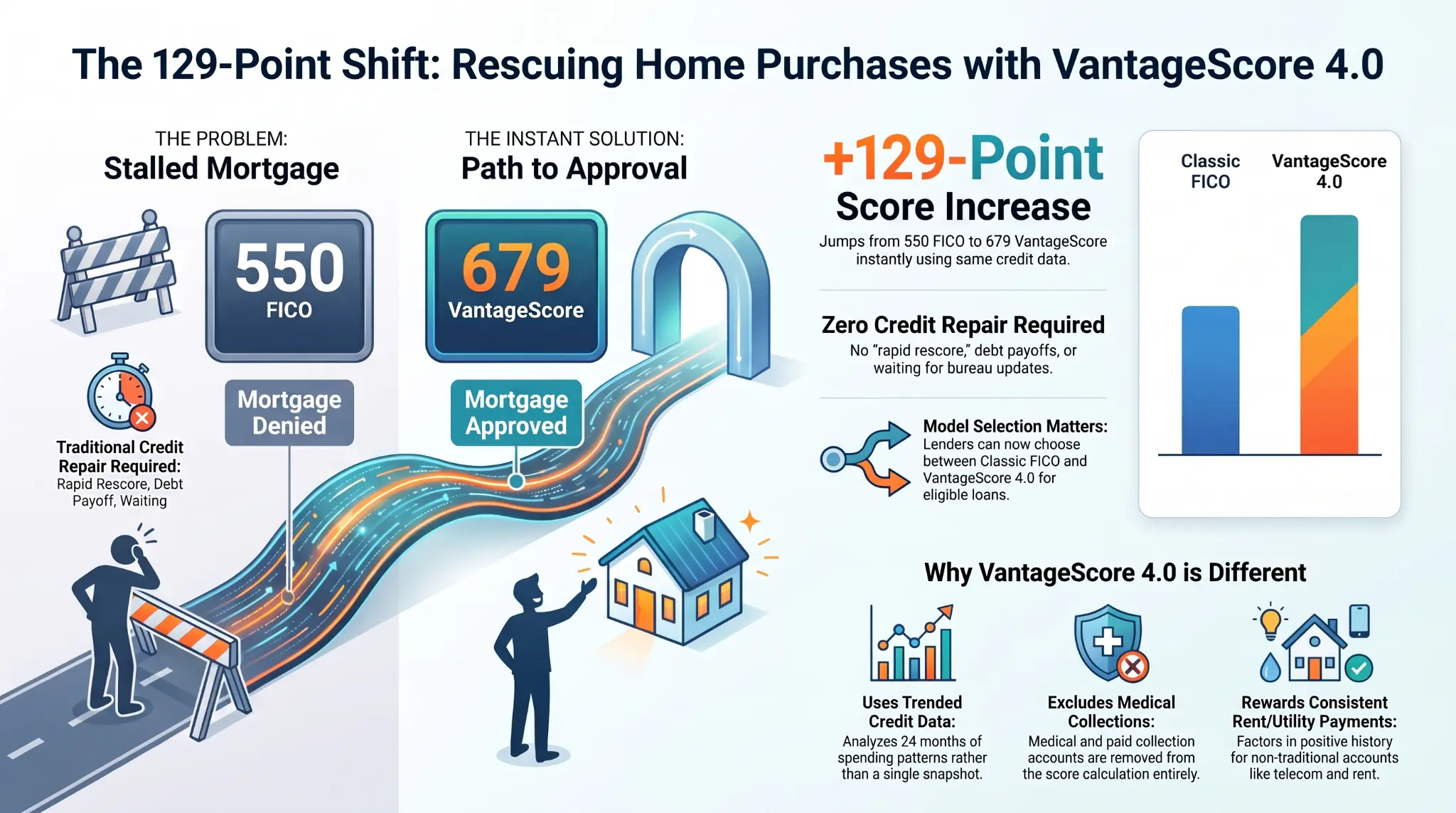
A 129-point spread is not normal.
Many borrowers see a much smaller difference between scoring models. Another buyer might see little change or might receive a lower VantageScore.
This client's result was exceptional. But it was real, and it helped keep her purchase moving.
What Is VantageScore 4.0?
VantageScore is a credit scoring system developed through a joint venture involving Equifax, Experian, and TransUnion.
Like FICO, it reviews information in your credit reports and produces a score designed to estimate the risk of future missed payments.
VantageScore 4.0 uses a range of 300 to 850.
The model reviews factors such as:
- Payment history
- Credit card balances
- Credit utilization
- The age of your accounts
- Recent credit activity
- Collections and other derogatory accounts
- The number and types of accounts you have
VantageScore 4.0 also uses trended credit data.
Instead of looking only at your balances today, the model reviews up to 24 months of available balance and payment patterns.
For example, it might identify whether your revolving balances have been increasing, decreasing, or staying consistent.
This provides more context than a single snapshot of your credit on the day the report is pulled.
How VantageScore Treats Certain Credit Information
VantageScore 4.0 does not treat every account the same way as older mortgage scoring models.
One major difference involves medical collections.
VantageScore 4.0 excludes medical collection accounts from its score calculation. It also excludes paid collection accounts. A borrower with medical collections might receive a higher VantageScore than a Classic FICO mortgage score, depending on the rest of the credit file.
VantageScore 4.0 also has the ability to consider reported rental, utility, and telecom payment information.
Those payments must appear in the consumer's credit file. The model does not automatically find every rent or utility payment a borrower has made.
When positive rental history is reported, it might help provide a fuller picture of a borrower who has limited traditional credit.
This matters for people who pay their rent and household bills on time but have few credit cards, auto loans, or other traditional accounts.
Why Did Her Scores Differ by 129 Points?
There is no conversion chart between a Classic FICO mortgage score and VantageScore 4.0.
A 550 FICO score does not automatically equal a 679 VantageScore.
Each model uses its own formula.
Each model weighs payment history, balances, utilization, account age, collections, and recent activity differently.
VantageScore did not ignore our client's late payment.
The late payment was still part of her credit history.
VantageScore evaluated the late payment alongside the rest of her file differently than the traditional mortgage scoring model.
That different calculation produced a much higher qualifying score.
We received the result immediately because we did not need to change the credit report. We ordered a new report using another approved scoring model.
When Did Conventional Mortgage Lending Start Accepting VantageScore?
The Federal Housing Finance Agency announced in July 2025 that lenders would be allowed to use VantageScore 4.0 or Classic FICO for eligible loans sold to Fannie Mae and Freddie Mac.
On April 22, 2026, the agencies released updated implementation guidance.
FHFA now states that approved lenders may choose between Classic FICO and VantageScore 4.0 for loans sold to Fannie Mae and Freddie Mac.
The option is real and active.
Access is not yet universal.
Fannie Mae describes VantageScore availability as a limited rollout to approved lenders. Lenders outside the rollout must continue using Classic FICO until broader access becomes available.
Freddie Mac also accepts VantageScore 4.0 from approved sellers. Participating sellers must contact Freddie Mac for program availability, eligibility requirements, and delivery instructions.
This means your lender might offer VantageScore 4.0 today. Another lender might not.
The availability of this option has become another important question to ask when choosing a mortgage company.
Why This Change Matters
For decades, a borrower's mortgage options often depended on one family of older credit scoring models.
A low qualifying score might have stopped the purchase even when another modern scoring model viewed the borrower's overall history differently.
VantageScore 4.0 gives eligible lenders another approved method for evaluating risk.
VantageScore reports that its model is able to score approximately 33 million more consumers than some traditional models. This includes people with limited credit history or no recent activity on traditional credit accounts.
That does not mean 33 million people automatically qualify for mortgages.
Every borrower still needs to meet the loan's requirements.
The change means more borrowers might receive a usable credit score and a complete mortgage review.
Who Might Benefit From VantageScore 4.0?
Five buyer profiles tend to see the most meaningful difference between scoring models.
1. The buyer with medical collections. VantageScore 4.0 excludes medical collection accounts from its score calculation entirely. A borrower with medical debt on their report might receive a noticeably higher VantageScore than a Classic FICO mortgage score.
2. The buyer with paid collections. VantageScore 4.0 also excludes paid collection accounts. Classic FICO mortgage models can still count the history of a collection even after it has been paid. If your buyer paid off a collection and their FICO score did not move much, VantageScore may tell a different story.
3. The buyer with limited traditional credit. Someone who pays rent, utilities, and phone bills on time but has few credit cards or loans may score poorly under FICO simply because there is not enough traditional credit activity. VantageScore 4.0 can factor in reported rental and utility payment history, which gives that borrower a fuller picture.
4. The buyer who has been paying down debt. VantageScore 4.0 uses trended data -- up to 24 months of balance and payment history. If your buyer has been consistently reducing their credit card balances, VantageScore can recognize that pattern as a positive signal. Classic FICO looks at a single snapshot. VantageScore sees the direction of travel.
5. The buyer with one recent isolated credit event on an otherwise solid file. This was our client. One 30-day late payment on a small card. Everything else in her file was strong. VantageScore evaluated the late payment in the context of her full history differently than Classic FICO did. The rest of the file being strong is what made the gap possible. If the rest of the file is not strong, the gap will not be there.
A higher VantageScore does not guarantee approval. The only way to know whether the option helps is to have the correct mortgage report reviewed by a lender offering the program.
Who VantageScore 4.0 Will Not Help
It is worth being direct about this, because not every buyer will see a meaningful difference.
VantageScore 4.0 is not going to produce a dramatically different result for a borrower who has:
- Multiple late payments across multiple accounts
- A recent bankruptcy
- A foreclosure in the last couple of years
- Serious derogatory marks spread across the whole file
A different scoring model is still going to look at that file and see risk. The model evaluates the full picture. When the full picture shows a pattern of problems rather than one rough patch on an otherwise solid file, the gap between models will be small or nonexistent.
Do Not Confuse This With a Free Credit Score
Many people already receive a VantageScore through free credit-monitoring services.
The score shown online might not match the VantageScore used for a mortgage.
The monitoring service almost certainly shows VantageScore 3.0, not VantageScore 4.0. These are different versions of the same scoring family and they do not produce the same number. A buyer who sees a 690 on Credit Karma is looking at a VantageScore 3.0 result -- not the VantageScore 4.0 that a mortgage lender would pull. The two versions weigh credit information differently, and the score can differ meaningfully between them.
It might use information from only one credit bureau.
The lender will generally order a three-bureau merged report.
The reports might also have been updated on different dates.
Free credit-monitoring scores help you track general changes in your credit. They are not mortgage approvals.
You need a mortgage lender to review the correct scoring model, credit report, and qualifying score.
What About the Interest Rate?
The credit scoring model affects more than your approval.
Your score might affect:
- Your interest rate
- Mortgage insurance
- Loan-level pricing adjustments
- Lender credits
- Closing costs
- Available loan programs
- Down payment requirements
The VantageScore option used for our client came with additional pricing.
We compared the higher rate and payment against the cost and risk of waiting.
Waiting might have meant:
- Losing the home
- Delaying the closing
- Extending a lease
- Paying more rent
- Facing a future interest-rate change
- Starting the home search again
- Paying for another inspection or appraisal
The VantageScore option did not produce the lowest theoretical rate she might have received after the late payment was removed.
It gave her a path to complete the purchase now.
What Should You Do if a Late Payment Appears During a Home Purchase?
Call your loan officer before taking any action.
- Do not immediately dispute the account online.
- Do not close the account.
- Do not pay down balances without reviewing how the payment will affect your available cash and loan approval.
- Do not assume a creditor will update an account on the exact date promised.
Instead:
- Get the creditor's agreement in writing.
- Ask when the correction will be sent to each credit bureau.
- Request a deletion or correction letter.
- Save proof of every payment.
- Confirm automatic payments process each month.
- Ask whether a rapid rescore is available.
- Ask whether VantageScore 4.0 is available.
- Compare the rate, payment, costs, and timing of every option.
A small credit card might create a major mortgage problem. Do not ignore an account because its balance or minimum payment is low.
A missed payment still matters.
The Bigger Lesson
Our client went from a 550 qualifying mortgage score to a 679 in minutes.
Her underlying credit report did not change.
We did not wait weeks for the credit card company to remove the late payment.
We used another approved scoring model and found a path that kept her conventional purchase moving with 10% down.
VantageScore 4.0 will not help every homebuyer. It will not erase legitimate credit problems. It will not replace mortgage underwriting.
It gives certain borrowers another option when an older scoring model does not tell the full story.
For this client, the difference was 129 points. And it happened immediately.
Before assuming a low mortgage score ends your home purchase, have the entire file reviewed.
The first score might not be the only score available.
Does VantageScore 4.0 Help Your Specific File?
Answer 4 quick questions and see whether the new scoring model is likely to help or hurt your situation before you apply.
TAKE THE FREE QUIZ →No spam. For educational purposes only. Not a commitment to lend.
Call or text Keith Goeringer at (615) 955-0461 or start a soft-check application at applywithkeithgo.com. NMLS #488023, Barrett Financial Group, NMLS #181106.