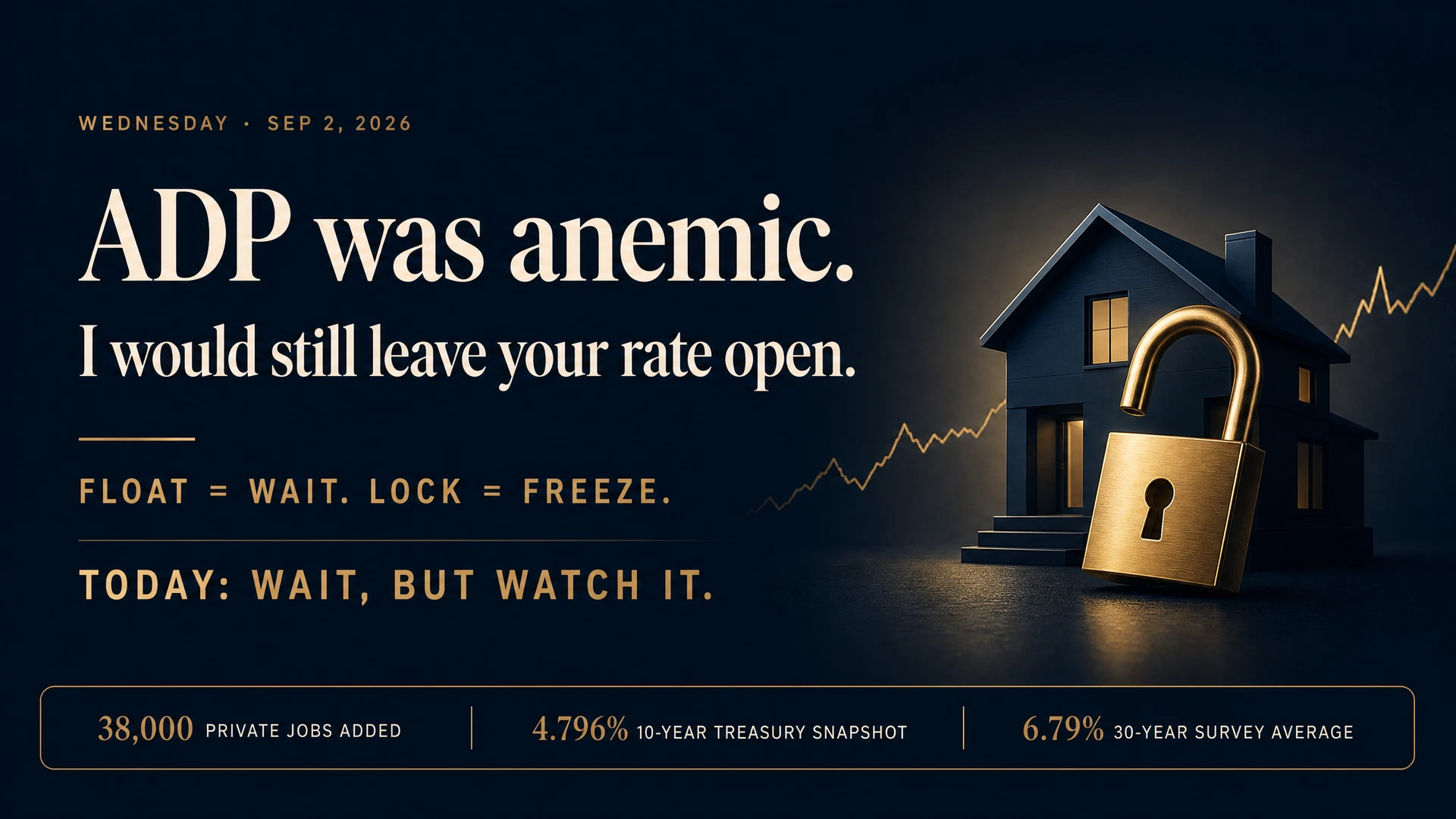
ADP came in weak this morning. I would still leave the rate open at the start of the day if the file has enough room.
That is a float. A lock freezes an agreed rate for a stated period. Carefully floating means you wait, but you keep watching the market and the payment.
ADP reported 38,000 private jobs added in August. The Reuters consensus was 48,000. The 10-year Treasury was still sitting at 4.796% after touching a multiyear high earlier in the day.
Weak hiring did not hand buyers a cheaper payment. I would wait, but I would not wander off.
38,000 private jobs, and no payment sale
ADP uses payroll data to estimate private employment before the government’s monthly jobs report.
August private employment rose by 38,000. July was revised from 44,000 to 46,000. Reuters had expected 48,000 for August.
This was the slowest private-job growth since January.
Education and health services added 45,000 jobs. Construction added 12,000, and leisure and hospitality added 16,000.
Manufacturing lost 17,000. Professional and business services lost 16,000. Across the broader totals, goods-producing industries lost 10,000 while service-providing industries added 48,000.
Small establishments added 3,000 jobs. Medium establishments were flat. Large establishments added 34,000.
That is a soft report. It is not proof that every part of hiring is falling apart, and it is not the same report the government releases Friday.
Why did the rate market stay stubborn?
The 10-year Treasury was little changed at 4.796% in CNBC’s September 2 market update.
Earlier in the day, it reached 4.818%, its highest level since November 2023.
A basis point is 0.01 percentage point. One hundred basis points equal one percentage point.
The 10-year Treasury is not your mortgage rate. Mortgage rates often move in the same direction, but mortgage-backed securities, lender pricing, loan details, and market conditions still determine your actual offer.
What did the mortgage-bond chart show?
The chart below is the market snapshot supplied with this update. It showed price trading near the lower part of the marked range at capture.
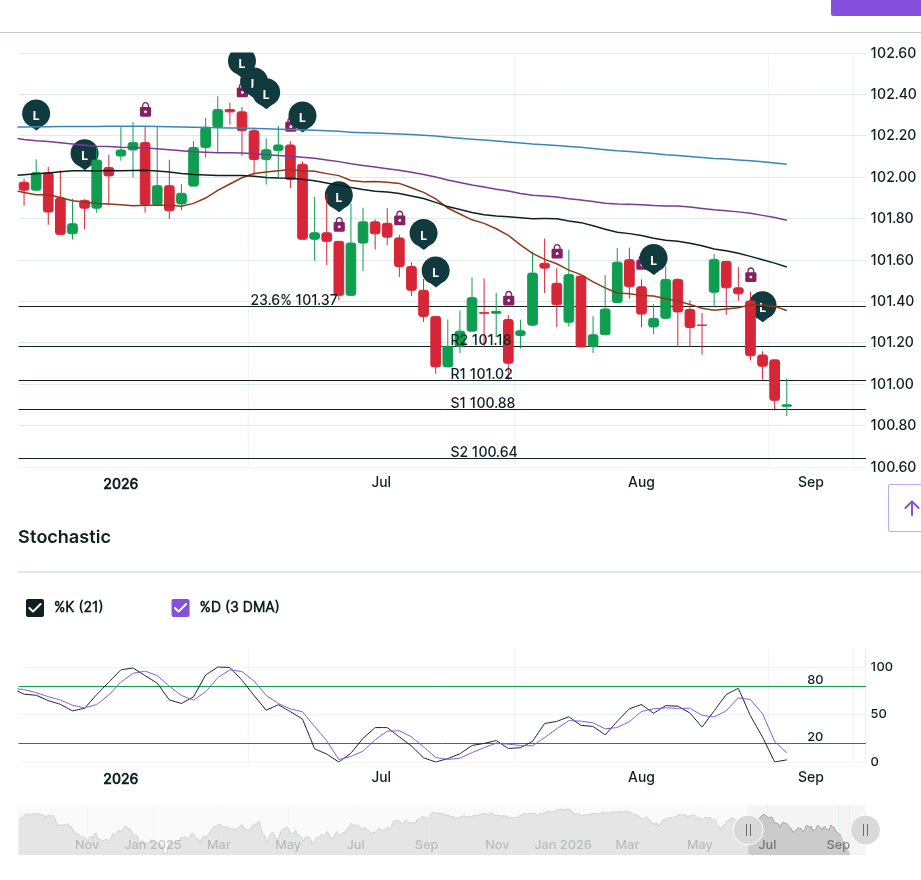
The visible reference levels were 101.18, 101.02, 100.88, and 100.64. The latest part of the chart was testing the lower section.
The gap from 100.88 to 100.64 is 0.24 price point. It should not be described as 24 basis points of mortgage rate movement.
These lines show where trading paused. They do not promise a bounce or a break.
Oil cooled, but the pressure did not disappear
Oil pulled back from its earlier high.
Reuters had U.S. crude at $89.51 per barrel, down 0.79%, and Brent at $94.22 in its September 2 update.
More than 17 million barrels of oil moved through the Strait of Hormuz on Monday. That helped show that some supply was still reaching the market.
The route remained exposed to conflict and shipping disruptions. That kept the inflation risk in the conversation even after oil moved lower.
Mortgage applications did not show a rate sale
The Mortgage Bankers Association’s weekly survey put the average contract rate for conforming 30-year fixed loans at 6.79%, up from 6.78%.
That is a survey average with specific loan-balance and points assumptions. It is not a personal rate quote.
Total applications rose 0.8% for the week. Seasonally adjusted purchase applications rose 2%.
Refinance applications fell 1% for the week and were 19% below the same week a year earlier. Refinances made up 41.8% of total applications.
The clean takeaway is that purchase activity moved a little higher even as the survey rate reached a four-week high.
What comes next?
The official August jobs report arrives Friday at 8:30 a.m. Eastern.
Reuters expected 56,000 nonfarm payroll jobs and 45,000 private payroll jobs when this update was written.
ADP does not predict the government report perfectly. Friday can still surprise in either direction.
A much weaker report could ease some rate pressure. A stronger report could push the other way. Neither outcome is guaranteed.
What I would do today
I would start by carefully floating if the closing is not too close and the current payment has room to move.
Then I would watch four things.
- How soon you close.
- How much payment change you can tolerate.
- How long the available lock lasts.
- Whether the lender offers a float-down if pricing improves later.
If the payment is already tight, the lock window is getting short, or a market move would break the budget, waiting may not be worth it.
The Consumer Financial Protection Bureau’s rate-lock guide explains why lock periods, extension costs, and application changes matter.
Yesterday’s setup is in The Jobs Report Was Soggy. I Would Still Leave Your Rate Open. Today’s ADP report was weaker, but the Treasury market stayed near its high.
If you are still shopping
Do not build your budget from last week’s quote. Run the payment again when you are ready to make an offer.
Use Why the Maximum Approval Is the Worst Number to Base Your Home Purchase On to separate what underwriting allows from what your household can live with.
Want me to check the file?
If you are 30 to 45 days from closing, send me the scenario. I want to see the current payment, closing date, lock period, extension policy, float-down terms, and how much movement you can tolerate.
If you are still looking, start the soft-check mortgage application. Then we can review the payment on a Pre-Purchase Zoom before you make an offer.
Follow Ratewatch Daily for the next sourced market update.
Sources and limitations
- ADP: Private-sector employment increased by 38,000 jobs in August.
- Reuters: August private payrolls and Friday jobs consensus.
- CNBC: September 2 Treasury yield and intraday high.
- Reuters: September 2 oil prices and supply risks.
- Reuters: Monday oil flows through the Strait of Hormuz.
- HousingWire: September 2 MBA weekly mortgage-application survey.
- Scotsman Guide: MBA rate, purchase, and refinance details.
- Consumer Financial Protection Bureau: What is a rate lock?.
Treasury yields, oil prices, mortgage pricing, and market forecasts change during the day. The figures above are September 2, 2026 snapshots from the cited times. The 6.79% figure is an MBA survey average, not a personal rate quote or APR. The hero shows public market figures, not an offer. This article is dated market commentary, not an offer to lend or a promise that floating will produce a better outcome. Lock and float-down terms vary by lender and loan.