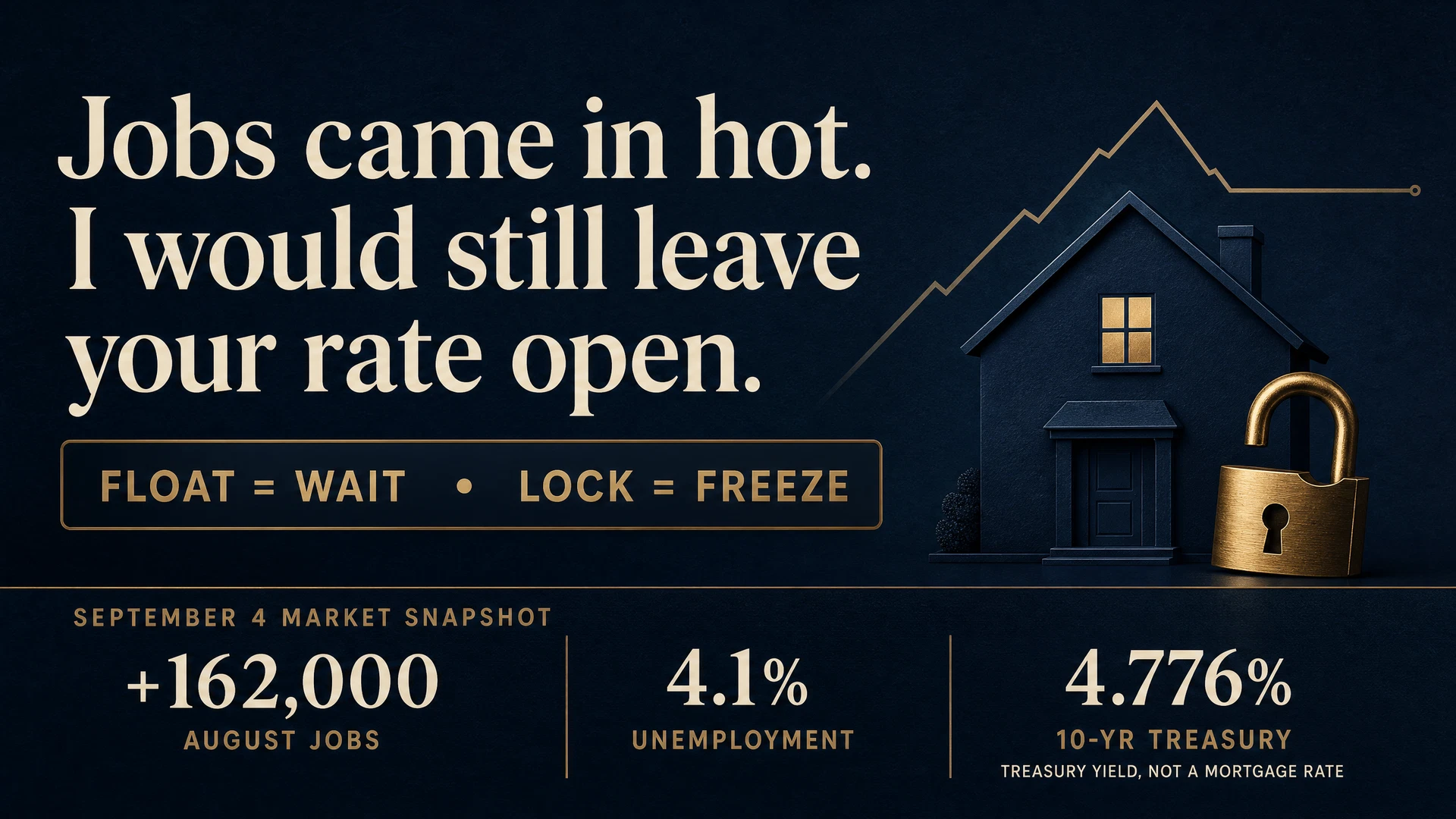
Jobs came in hot on September 4. I would still leave the rate open at the start of the day if the file has enough room.
That is a float. A lock freezes an agreed rate for a stated period. Carefully floating means you wait, but you keep watching the market and the payment.
August payrolls increased by 162,000. The Reuters forecast was 56,000. After the first market reaction settled down, Reuters reported the 10-year Treasury yield at 4.776%, up 1 basis point.
The report put more pressure on the rate market. It did not make locking the right call for every file.
My call is to wait, but watch it.
What did the August jobs report actually show?
Total nonfarm payroll employment increased by 162,000 in August. That was nearly three times the 56,000 forecast in the Reuters poll.
Unemployment stayed at 4.1%.
The gains were not all in one corner. Leisure and hospitality added 62,000 jobs. Food services and drinking places accounted for 59,000 of that increase. Local government education added 42,000. Construction added 22,000, manufacturing added 16,000, and health care added 13,000.
Information employment lost 23,000 jobs.
The report was stronger than the forecast. It was also preliminary.
Did the prior months get revised?
Yes. June was revised from a 20,000 gain to a 31,000 gain.
July was revised from a 23,000 loss to a 21,000 gain. That is a 44,000 change for July.
Together, June and July were revised up by 55,000 jobs.
That is why I do not build a rate decision from one headline. The first estimate can change as more payroll reports reach the government.
Was the unemployment rate hiding a weaker labor force?
Not this month. The labor force increased by 683,000, and the participation rate moved from 61.4% to 61.6%.
Household-survey full-time employment increased by 735,000. Part-time employment fell by 223,000. The number working part time for economic reasons fell by 414,000 to 4.390 million.
Those are healthier details than a low unemployment rate created by people leaving the labor force.
The household and payroll surveys measure different things. Do not add their numbers together.
Why did the private payroll reports disagree?
The official report counted 127,000 private payroll jobs. ADP reported 38,000 private jobs two days earlier.
The industry details were different too. The official report showed leisure and hospitality up 62,000. ADP reported a 16,000 gain for that sector.
These are different reports built from different data and methods. The gap does not prove one is fake. It tells you to slow down before turning one monthly number into a clean story.
What happened to the 10-year Treasury?
Treasury yields rose when the report hit, then the move cooled.
Reuters reported the 10-year Treasury yield at 4.776%, up 1 basis point, after a larger early move faded.
A basis point is 0.01 percentage point. One hundred basis points equal one percentage point.
The 10-year Treasury is not your mortgage rate. Mortgage-backed securities, lender pricing, loan details, and market conditions still affect the rate offered on one file.
What did the mortgage-bond chart show?
The chart below is the mortgage-bond snapshot supplied with this update.
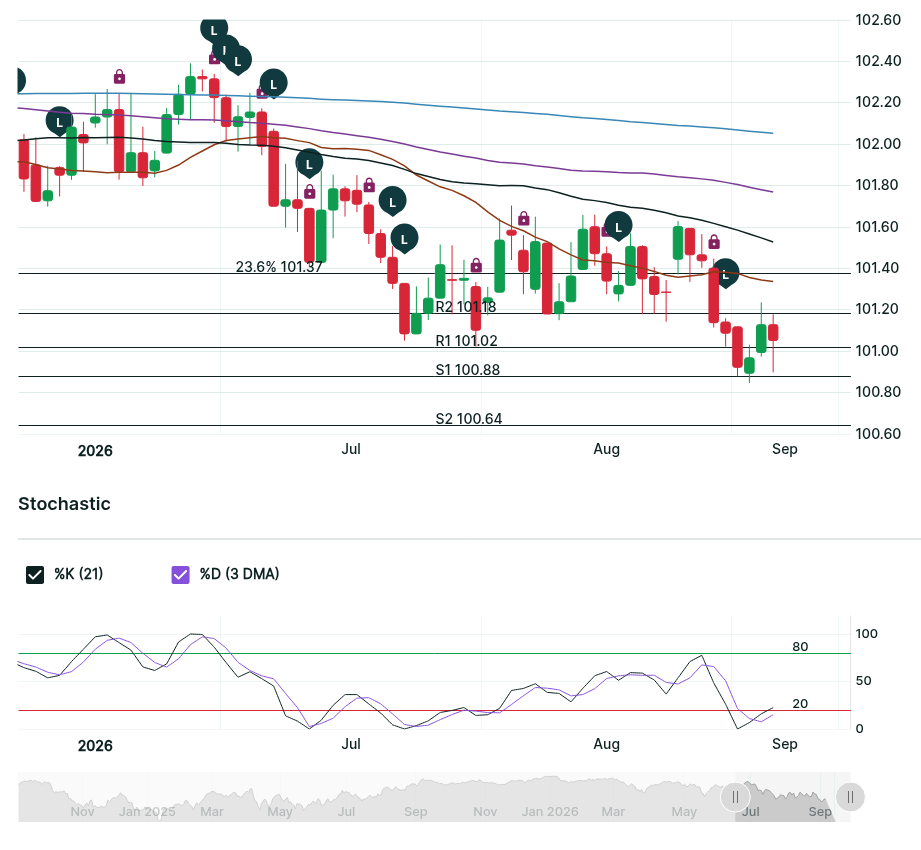
The chart labels 101.37, 101.18, 101.02, 100.88, and 100.64. Those are mortgage-bond price levels, not mortgage rates.
The image did not come with a public timestamp or an independently verifiable data feed. I am using it as a market illustration, not proof that one line must hold.
What does the report mean for the Fed?
The jobs report kept a September rate hike in the conversation.
One Reuters snapshot put the market-implied chance at 59%, up from 55% before the report. A later update put it near 62%.
Those odds changed within a few hours. They are market prices, not a Fed promise.
The next inflation reports still matter. August PPI is scheduled for Thursday, September 10. August CPI is scheduled for Friday, September 11. The Fed meets September 15 and 16.
What happens over the holiday weekend?
SIFMA recommends a full U.S. fixed-income market close for Labor Day on Monday, September 7.
That means the next full trading day arrives Tuesday. A long weekend does not guarantee Tuesday opens where Friday closed.
What I would do today
I would carefully float if the closing is not too close and the current payment has room to move.
Then I would watch four things.
- How soon you close.
- How much payment movement you can tolerate.
- How long the available lock lasts.
- Whether a float-down is available if pricing improves later.
If the payment is already tight, your closing is close, or a quick market move would break the budget, waiting may not be worth it.
The Consumer Financial Protection Bureau’s rate-lock guide explains why lock periods, extension costs, and changes to the application matter.
If you are still shopping
Do not build your budget from last week’s quote. Run the payment again when you are ready to make an offer.
Use Why the Maximum Approval Is the Worst Number to Base Your Home Purchase On to separate what underwriting allows from what your household can live with.
Yesterday’s setup is in Waller Leaned Against a Hike. I Would Still Leave Your Rate Open.
Want me to check the file?
If you are 30 to 45 days from closing, send me the scenario through Ask Keith. I want to see the current payment, closing date, lock period, extension policy, float-down terms, and how much movement you can tolerate.
If you want to talk it through, book a mortgage call. If you are still looking, start the soft-check mortgage application before you make an offer.
Follow Ratewatch Daily for the next sourced market update.
Sources and limitations
- Bureau of Labor Statistics: August 2026 Employment Situation.
- Reuters: August payroll growth, unemployment, revisions, industry details, and market reaction.
- Reuters: September 4 Treasury yield and first Fed-futures snapshot.
- Reuters: Later September rate-hike probability and inflation context.
- ADP: August private-sector employment report.
- SIFMA: 2026 U.S. fixed-income holiday recommendations.
- Bureau of Labor Statistics: August PPI release schedule.
- Bureau of Labor Statistics: August CPI release schedule.
- Federal Reserve: 2026 FOMC meeting calendar.
- Consumer Financial Protection Bureau: What is a rate lock?.
Payroll figures are preliminary and subject to revision. Treasury yields, mortgage-bond prices, and futures probabilities change during the day. The figures above are September 4, 2026 snapshots from the cited times. The hero shows public labor and Treasury figures, not a mortgage-rate offer. The supplied chart is an illustration, not an independently verified data feed. This article is dated market commentary, not an offer to lend or a promise that floating will produce a better outcome. Lock and float-down terms vary by lender and loan.