
Real property or loan details do not prove that a message is legitimate. Before you pay, click, call, or share personal information, verify the request through your county website, a recent mortgage statement, an official account you already use, or a phone number already saved in your contacts.
The second you buy a house, you become easier to find.
Your name, address, purchase price, recording date, and document numbers may be available through public records. That information can help a private solicitation look like a bill from your county, lender, title company, or mortgage servicer.
That is the part that catches people.
The $98 letter that looked real
One of my clients received a letter with “Clerks Property Office” printed across the top. It listed the property address, Williamson County records, a property ID, a document number, the purchase date, and the purchase price.
It also had a requested response date and a $98 service fee.
At the bottom was a place to write a credit card number, expiration date, and security code.
My client almost paid it.
Then they took a picture and texted me.
That one text stopped the payment.
What was the company selling?
The fine print said the company was offering a copy of the recorded deed and a property profile. It also said the documents could be available from the local county office for free or at a lower cost.
The letter disclosed that the company was not affiliated with a government agency.
You had to read past the official-looking heading, county information, and deadline to find that out.
The Davidson County Register of Deeds has warned homeowners about a similar official-looking letter. That mailing falsely suggested a deed had been transferred and asked for an $89 service fee.
Some private document services sell a real product. The problem is the presentation. A solicitation can look like a required county bill when it is not.
I covered deed-copy letters in more detail in Fake Mortgage Mail Is Flooding Mailboxes. This post goes further because the same verification problem now shows up in mail, email, texts, calls, and meeting links.
How did they know so much about the house?
Property records can reveal more than many homeowners expect. A recorded deed or mortgage document may connect a name, address, recording date, document number, and transaction details.
That information may be real.
The sender’s identity may still be false.
This is the mental trap. You see details that feel private, so you assume the person who sent them must be connected to your transaction.
Do not use accurate property details as proof. Verify the sender through a second source.
The rule that stops most of these scams
Stop. Verify. Then respond.
Do not call the phone number printed on a letter you are trying to verify. Do not click the link in an email you are trying to verify. Do not use payment instructions from a text you are trying to verify.
Start over through a source you already trust.
- Mortgage or escrow question: Use the servicer phone number on a recent mortgage statement or sign in through the official account you already use.
- Deed or property-record question: Find the Register of Deeds through the official county website. Williamson County directs property owners with deed or plat questions to its Register of Deeds office.
- Homeowners insurance question: Call the agent or carrier through the number on your current policy.
- Title question: Call the title company using the closing documents you already have.
What homeowner mail should you slow down and check?
After closing, you may receive offers involving:
- Mortgage protection products
- Home warranties
- Property monitoring
- Deed or property-record copies
- Biweekly mortgage-payment services
- Homestead filing services
- Refinancing
- Loan modifications or foreclosure relief
- A change in mortgage servicing
Some of these are ordinary advertisements. Some sell products you may want. Some are misleading. Some are fraud.
Your job is not to guess which category a letter belongs in. Your job is to verify it before you send money or information.
What are the mortgage-relief scam warning signs?
The Federal Trade Commission warns about companies that demand money before providing mortgage-relief services. Other warning signs include requests for a cashier’s check, wire transfer, or payment app.
Be careful if someone tells you to stop talking with your lender, send your mortgage payment to a different company, or transfer the deed to your home.
The Federal Housing Finance Agency also warns that fraudsters may spoof a mortgage servicer’s identity to collect passwords, personal information, financial information, or payments.
If you are having trouble with the mortgage, call the real servicer through a recent statement. Do not let a stranger separate you from the company that actually handles the loan.
Email scams can look clean now
A phishing email does not need bad spelling or a strange design.
I clicked a link in a message that looked like it came from a company I use for advertising. The address looked close. The page looked familiar. I caught it after the click, but it was a good reminder that this can happen to anyone.
CISA says urgent language, requests for personal or financial information, shortened links, and lookalike addresses are common phishing signs. It also says good grammar is no longer a reliable safety check.
If a message might be real, do not use the link or phone number inside it. Type the company’s known website yourself or call through a number you already trust.
What should you do with a suspicious meeting link?
A fake meeting invitation is still a phishing link.
Someone may say they want to discuss a house, a refinance, an investment, or a business opportunity. Then they send a meeting link and ask you to join right away.
Do not decide the link is safe because it includes a familiar company name somewhere in the address.
Open the official meeting app yourself or type the known website address into your browser. Contact the sender through a separate email address or phone number and ask them to confirm the meeting.
If the page asks you to install an update, enter a password, or give remote access to the computer, close it. Go to the software company’s official site if an update is really needed.
AI voice cloning changes family emergency scams
The voice on the phone may sound exactly like someone you love.
The FTC warns that scammers can clone a family member’s voice from a short audio clip. The caller may claim there was an accident, arrest, or another emergency and ask for money fast.
Hang up. Call the person through a number already saved in your phone.
The National Cybersecurity Alliance recommends a private family safe word or verification phrase. Choose something that is hard to guess and never post it online.
A safe word is one check. A callback through a known number is another.
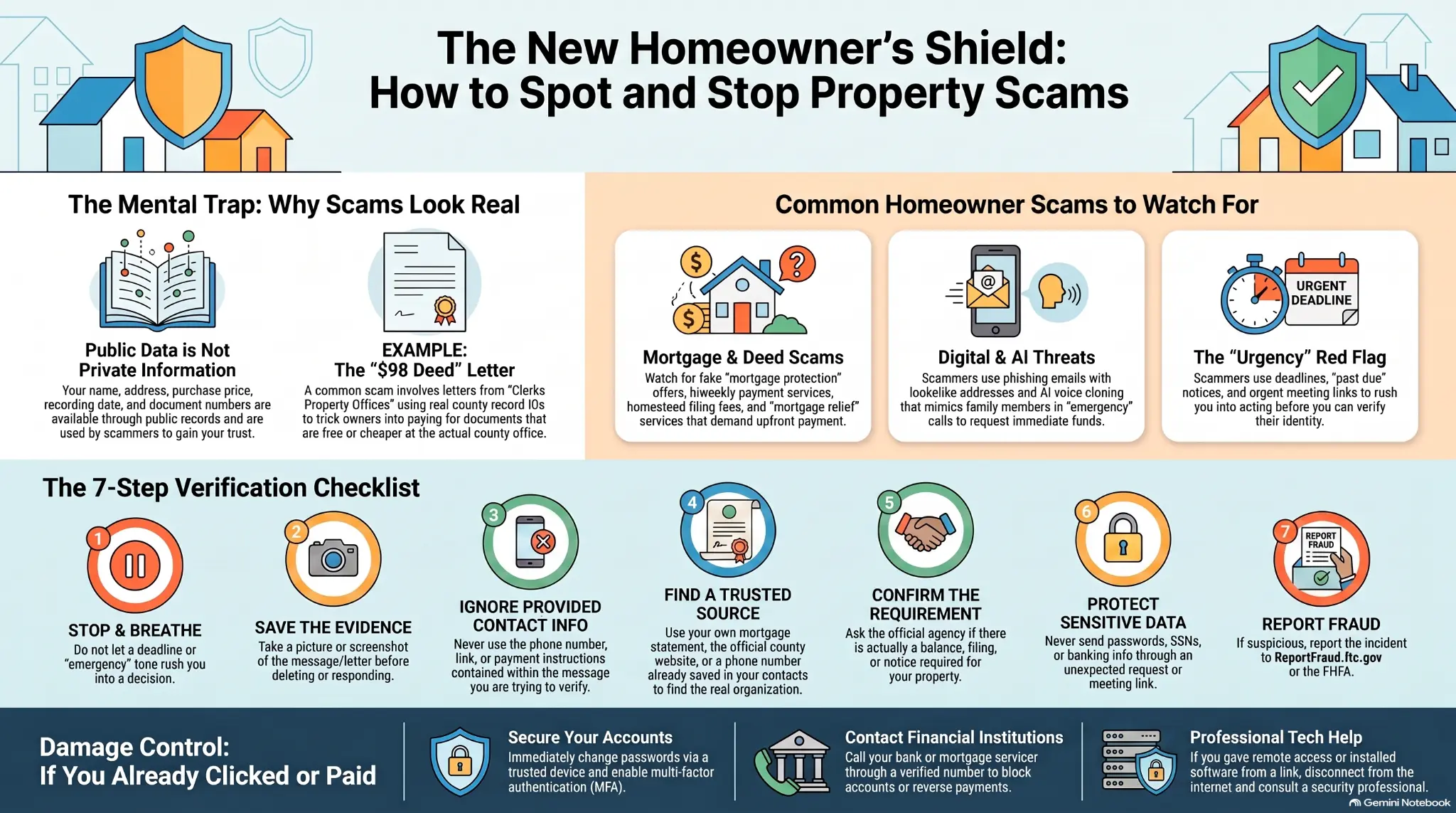
Use this seven-step verification checklist
- Stop. Do not let a deadline or emergency message rush you.
- Save the evidence. Take a picture or screenshot before deleting anything.
- Do not use the message’s contact information. Find a separate trusted source.
- Verify the sender. Call the county, servicer, insurer, title company, or family member through a known number.
- Ask what is actually required. Find out whether there is a real balance, filing, notice, or meeting.
- Protect your accounts. Do not send passwords, security codes, Social Security numbers, card details, or banking information through an unexpected request.
- Report fraud. Use ReportFraud.ftc.gov. If mortgage or cyber fraud is involved, the FHFA page also lists its reporting process.
What if you already clicked or paid?
Act quickly.
If you entered a password, change it through the real website from a device you trust. Change any other account that reused the same password. Turn on multifactor authentication.
If you gave out card, bank, or mortgage-account information, call the financial institution through a verified number. Tell them what happened and ask what needs to be blocked or replaced.
If you paid, contact the company that handled the payment and ask whether it can be stopped or reversed. Then report the incident through the FTC.
If the device installed software or you gave someone remote access, disconnect it from the internet and get help from a qualified computer-security professional.
My job does not end when your mortgage closes
You are going to receive mail about the house. Your servicer may change. Taxes and escrow payments can change. Refinance offers will show up.
Some messages will be real. Some will be ads. Some will be designed to scare you into acting before you think.
If you closed with me and something feels wrong, take a picture and send it to me. I would rather answer one extra text than hear that you paid the wrong person.
If you are still in the buying process, read You’re Pre-Approved. Now What? and You’re Under Contract. Now What?. Those guides explain which real documents and requests you should expect before closing.
Sources and what to verify
- Davidson County Register of Deeds: Property Owners, Be Alert: Deed Letter Is a Scam.
- Williamson County Property Data Search for deed and plat questions.
- Federal Trade Commission: Mortgage Relief Scams.
- Federal Housing Finance Agency: Fraud Prevention.
- CISA: Recognize and Report Phishing.
- Federal Trade Commission: AI Family Emergency Schemes.
- National Cybersecurity Alliance: Safe Words in the Age of AI.
This article is for education. County procedures, fees, mortgage-servicing practices, software guidance, and reporting steps can change. Use a current official source before you pay, share information, or act on a notice.
Got a questionable letter, email, text, call, or link? Call or text me at 615-955-0461.